A blank dishwasher panel doesn’t automatically mean the appliance needs replacing. A dishwasher control panel not working in Gilbert may be caused by lost power, an active control lock, a door-latch or door-switch issue, or an electronic control fault. The symptoms offer clues: a dark display calls for different initial checks than buttons that light up but don’t respond.
It’s frustrating when you can’t start a cycle and dishes are waiting. A few safe checks can help narrow down the cause, but opening the control panel or testing live electrical parts isn’t a job for an untrained homeowner. This guide explains what the panel does, which external checks are safe, what symptoms may point to a deeper fault, and how to weigh repair against replacement. It also covers when to stop troubleshooting and arrange professional diagnosis.
Key Takeaways
- A dark display and buttons that light up but won’t respond can point to different problems, so note exactly what the panel does.
- Check simple causes first, such as a control lock or interrupted power, before considering an internal component failure.
- Stop using the dishwasher if you notice a burning smell, visible electrical damage, or water near electrical parts.
- Repeated control-panel trouble may signal an underlying fault, not just a failed touch surface.
- Compare the dishwasher’s condition and likely repair scope with replacement before deciding what makes sense.
Electrical damage and repeat control-panel failures
A control panel that fails again after replacement needs more than another part swap. In August 2011, a reported GE PDW9280J00SS dishwasher’s control panel or board melted and charred the stainless steel. That example shows why visible heat damage deserves immediate attention. If you notice scorching, a burning odor, smoke, or unusual heat, stop using the dishwasher and seek qualified professional service.
A recurring problem can involve the panel cover, control board, wiring, or another connected component. Dishwasher owners have described replacing a control-panel cover more than once, or seeing a fault return after the panel or board and control wiring were replaced. These accounts don’t establish a universal cause. They do show why repeated symptoms call for a closer diagnosis.
A new board may not fix a fault elsewhere in the circuit. A damaged connection, moisture intrusion, or another electrical problem could affect operation, but symptoms alone can’t identify the failed part. A technician needs to inspect the relevant components and wiring. Replacing parts without finding the underlying fault may leave the dishwasher prone to another failure.
Start by noting what happened before the failure. Did the display go dark or flicker, or show signs of heat? Did the buttons stop responding after a cycle, or did the problem return soon after a repair? Record the dishwasher model from its label and when each symptom appeared. A clear timeline gives a technician specific details to investigate.
Keep your inspection external. Look for visible scorch marks, melted plastic, a burning smell, or damaged wiring you can see without removing panels. Don’t open the control console or touch internal wiring. Electrical testing and access to energized components can be hazardous. If a breaker trips when the dishwasher runs, leave it off and arrange qualified service rather than repeatedly resetting it.
A door-latch symptom can overlap with an electronic-control problem. For example, the door may not seem to catch, or the dishwasher may refuse to start even when the door is closed. That doesn’t prove the control board is faulty. The latch or door switch may be involved, so a complete diagnosis should assess the door hardware and controls together.
When a control failure recurs, share the repair history, replaced parts, and timing with the technician. Mention the five-week recurrence if that matches your situation, and describe any visible heat damage. A careful inspection can distinguish a failed panel from a wiring or related component issue. Stop using the appliance if electrical damage or burning signs appear.
Possible failure of the front touch panel
A front touch panel can fail even when the dishwasher still has power. One clue is selective response: the display lights, but pressing Start does nothing, or one setting button works while another doesn’t. That differs from a completely dark display, which may point to a power or control issue. Neither symptom identifies the failed part by itself.
The front panel is the surface homeowners use to choose and start cycles. Behind it, electronic controls interpret button presses and manage dishwasher operation. Depending on the design, the touch surface and control board may be separate parts. A fault in either area can produce similar symptoms, so replacing the visible panel without assessing related controls may miss the cause.
A reported GE PDW9280J00SS owner said the control panel failed in 2007 and was replaced under warranty. That example shows a panel failure can occur, but it doesn’t establish a pattern for every dishwasher. Brand, model, age, and symptoms all matter. Use the model label to identify the appliance before discussing parts or repair options.
Observe the panel before trying further checks. Note whether the display is dark, whether any indicator lights appear, and which buttons respond. For example, if Cycle Selection changes but Start doesn’t, report that exact difference. Also note whether the response changes after you open and firmly close the door. A door-switch or latch issue can resemble a control-panel fault.
- Lights appear, but no buttons respond: the touch surface or connected controls could be involved.
- Only one button fails: a localized touch-panel problem is possible, but the symptom alone isn’t proof.
- No display or lights: consider power and control faults before assuming the touch surface failed.
- Buttons respond inconsistently: record which settings work and when the problem occurs.
Keep checks external. Don’t pry off the panel, expose wiring, or spray cleaner into button seams. Moisture or cleaning residue can complicate diagnosis, and internal electrical testing isn’t a safe homeowner task. If you see melting, smell burning, or notice heat at the controls, stop using the dishwasher and seek qualified service.
Clear symptom notes help separate a touch-panel fault from a latch, switch, or control issue. Share the model number and the exact buttons affected during professional dishwasher diagnosis. A technician can assess the interface and related components before recommending a repair.
Repair versus replacement decisions
Base the decision on the dishwasher’s condition, repair history, and diagnosed fault. A panel issue on an otherwise dependable appliance may call for a different choice than a control problem accompanied by poor cleaning, drainage trouble, or repeated breakdowns. Age is relevant, but it shouldn’t determine the outcome by itself. Consider how the dishwasher has performed and what the diagnosis shows needs attention.
Ask what the proposed repair would address. The diagnosis should identify the faulty component and explain whether other parts contribute to the symptom. If the control panel has failed, clarify whether the work addresses only the interface or includes related control components. That distinction helps you compare the repair plan with the dishwasher’s overall condition, rather than judging by the name of one part.
Consider the repair history, too. A first control issue on a dishwasher that has otherwise worked reliably differs from a fault that returned after previous work. If the same symptom has come back, share when it happened and what was replaced. Recurring problems may affect whether another repair makes sense, especially if the dishwasher has other ongoing performance concerns.
Manufacturer warranty and home-warranty coverage depend on the applicable contract and the particular failure. Review the dishwasher’s warranty documents and your plan’s terms to see whether control-panel diagnosis or repair is covered. Conditions vary, so don’t assume a panel fault qualifies just because another repair was covered.
Use these questions to frame the decision:
- Overall performance: Before the panel problem, did the dishwasher clean and drain as expected?
- Repair history: Has the same fault returned, or have other issues appeared?
- Diagnosis: Does the finding explain the symptoms and identify the work proposed?
- Replacement needs: Would replacing the appliance address concerns beyond the control panel?
For example, a dishwasher with one diagnosed control fault and no other recurring concerns may be a reasonable repair candidate. If an older appliance has a recurring control problem along with other performance issues, compare the complete repair plan with replacement. The decision depends on the overall picture, not the calendar age alone.
Before approving either option, gather the model information and any prior service records. Ask for a clear explanation of the diagnosis, the components involved, and the dishwasher’s condition. Those details help you decide whether another repair is likely to address the problem or replacement better suits your household. A sound choice starts with understanding the fault and the appliance’s broader history.
Troubleshooting a dishwasher with an unresponsive control panel
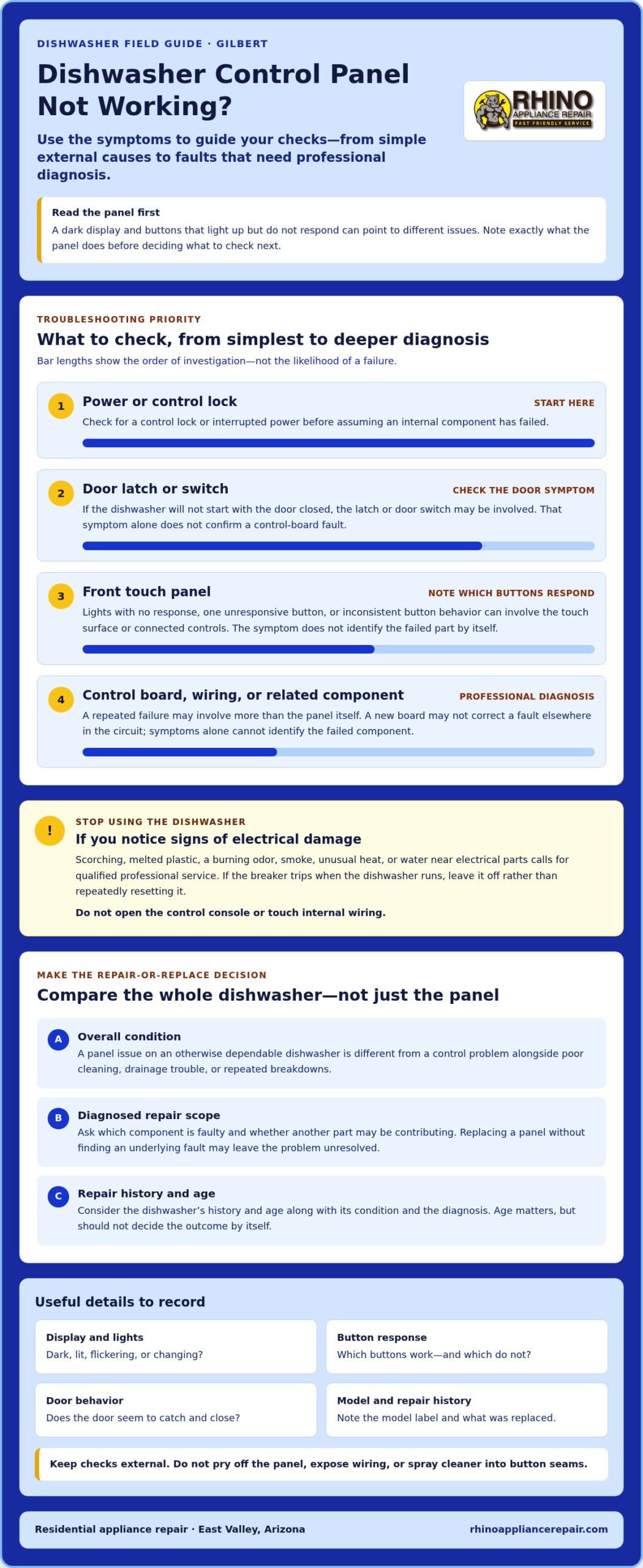
If your dishwasher control panel isn’t working in Gilbert, begin with checks that don’t expose wiring. Note whether the display is dark, whether buttons respond, and whether the dishwasher starts and stops.
Common Causes of Panel Failure
An unresponsive panel can result from interrupted power, a faulty door latch or switch, or an electronic control issue. Different faults can cause similar symptoms, so the display alone can’t identify the failed part. For example, a dishwasher may refuse to start because it doesn’t detect a closed door. Recording the exact behavior helps narrow down what to investigate.
Safety Precautions Before Troubleshooting
Safe troubleshooting means keeping checks external and stopping if an electrical or water hazard appears. Don’t remove the control panel, handle wiring, or test live components. If you see smoke or scorching, or find water near electrical parts, stop using the dishwasher and seek qualified service. Keep your hands and the floor dry, and don’t touch plugs or switches with wet hands.
Begin with the door. Open it and move any dish or rack that blocks closure, then close it normally. A latch or door-switch fault can prevent a cycle from starting. Don’t force a door that won’t catch. Note whether the latch feels loose or the panel responds differently after closing.
Next, check simple external causes. Confirm the dishwasher’s breaker hasn’t tripped, and consult the manual for a control-lock setting. If power is interrupted, follow the manual’s reset guidance. Don’t repeatedly reset a breaker that trips again. Leave it off and arrange qualified electrical service.
Match the symptom to what the appliance does:
- No lights or display: note whether nearby lights or appliances also lack power.
- Lights appear, but Start won’t respond: check the door closure and lock setting.
- The cycle starts, but water doesn’t enter: verify the water supply is turned on.
- The dishwasher won’t drain: check for visible obstructions before blaming the controls.
- Water keeps filling: stop using it; a float switch, timer, or inlet valve may need replacement.
Don’t dismantle the panel to investigate a pump symptom. A pump problem can resemble a control fault, so assess the draining issue first. If there’s a leak, inspect only visible areas, including the exposed drain hose. Look for cracks or damage, but don’t remove parts or reach beneath a wet appliance.
For a dishwasher control panel not working in Gilbert, record the model number, symptoms, and checks you’ve completed. If safe external checks don’t explain the problem, professional diagnosis can determine whether the latch, switch, or electronic control needs attention.
What causes a dishwasher control panel to stop working?
A panel may seem faulty when a setting prevents normal input or when its interface can no longer send commands. The distinction matters: a selected mode may only need changing, while a damaged component needs diagnosis. Button behavior, display messages, and whether one control or several are affected can help tell these possibilities apart.
A control-lock feature can make buttons seem inactive. It’s designed to prevent unintended input during operation or cleaning. A delay-start selection can also make a dishwasher seem unresponsive when it’s actually waiting to begin. These settings don’t necessarily indicate a failed panel. The model’s manual explains how its indicators and controls work.
The touch surface itself may stop registering input consistently. A button that responds only when pressed in a particular spot, or stops working while neighboring controls respond, may indicate an interface problem. Greasy film or dried cleaner on the surface may also interfere with touch response. Clean only as the manufacturer directs, using a soft cloth and keeping liquid away from the panel edges.
In other cases, the panel registers input, but the electronic control doesn’t interpret or act on it correctly. A display that changes while the selected cycle doesn’t reflect that choice may point beyond the button surface. Dishwasher designs differ: the user interface and control functions may be separate or combined. That design affects what diagnosis and repair may involve.
Recurring or changing symptoms can provide useful clues. One button failing while others work differs from several controls becoming erratic together. A panel that responds inconsistently after cleaning also differs from one that never registers a particular selection. These patterns don’t prove a specific part has failed, but they help describe the problem precisely.
Age, regular use, and past exposure to moisture can affect electronic interfaces over time. Don’t pour cleaner directly onto the controls or try to lift the panel surface. If buttons remain unresponsive after consulting the manual and cleaning the exterior safely, leave internal inspection to a qualified technician. Opening the console can expose wiring and components that homeowners shouldn’t handle.
Before arranging diagnosis, write down which selections work, any display messages, and whether the problem is constant or intermittent. Include the dishwasher’s model information. These details help distinguish an enabled setting from an interface or control fault. Similar symptoms can have different causes, so both the panel’s behavior and the appliance’s design matter when deciding what to do next.
Rhino Appliance Repair: Refrigerator Repair
Rhino Appliance Repair provides residential Dishwasher Repair as well as Refrigerator Repair for homeowners. A dishwasher control-panel fault is a specific issue, so use the safe checks above and avoid opening the control console or handling wiring. If another appliance at home needs attention, clear symptoms and the model information can help explain what’s happening and guide the next step.
For refrigerator concerns in Gilbert and nearby East Valley communities, contact Rhino Appliance Repair to discuss the issue. You’re also welcome to visit rhinoappliancerepair.com.
Get a Clear Next Step for Your Dishwasher
If your dishwasher control panel isn’t working in Gilbert, treat the problem as a reason to make a considered repair decision, not to replace the appliance immediately. A focused diagnosis can clarify what needs attention and help you decide whether the dishwasher still suits your household. That gives you a practical basis for planning a repair or weighing replacement.
When the appliance’s history is unclear or the problem keeps returning, professional diagnosis can help you move forward without guessing. Rhino Appliance Repair provides residential Dishwasher Repair, along with Refrigerator Repair, Freezer Repair, and Ice Maker Repair. Contact the team with the model information and what you’ve observed to discuss the issue and the next step.
Contact Rhino Appliance Repair today to discuss your appliance repair needs and take the next step with confidence.
Frequently Asked Questions
What Is a Dishwasher Control Panel and Why Is It Important?
The control panel is the dishwasher’s user-facing interface for choosing commands and, on many models, viewing status information. It lets you select the options built into that appliance, not just start a cycle. If the panel is unreadable or unresponsive, you may lose access to those selections even if other components remain operational. The exact controls vary by model.
How do you reset a dishwasher control panel safely?
Follow the reset instructions in the owner’s manual for your specific model. A reset may clear a temporary control state, but it won’t repair a failed component. Manuals differ, so don’t rely on a button sequence meant for another dishwasher. If the appliance shows visible electrical damage, smells burnt, or has water near electrical parts, stop using it and seek qualified service instead of attempting a reset.
How can you troubleshoot a dishwasher control panel that is unresponsive?
Record any displayed error code exactly as shown, including letters, numbers, or flashing indicators. Check the manual’s model-specific description before interpreting it, since codes and display patterns differ between dishwashers. Note whether the panel display changes after a selection, even if the cycle doesn’t proceed. This gives a technician a clearer starting point than a general report that the controls stopped working.
How do you check whether a dishwasher control lock or delay setting is enabled?
Look for a lock symbol, a labeled control, or a delay indicator on the display, then compare it with the symbols in your model’s manual. A countdown or delayed-start indicator can explain why a cycle hasn’t begun immediately. Don’t assume an unfamiliar light signals a fault; note its appearance and check the manual’s description for your dishwasher.
When does a dishwasher control panel need replacement instead of repair?
Replacement may be considered when diagnosis identifies a failed panel assembly that can’t be repaired as an individual component. Designs differ by model, so a technician needs to determine whether the fault lies in the touch interface, its connection, or another control component. Ask which part failed and whether the proposed replacement addresses that finding. A dark or unresponsive display alone doesn’t establish that the entire panel needs replacing.
What is the typical cost to repair or replace a dishwasher control panel?
There isn’t one typical amount that applies to every dishwasher model and control fault. The scope depends on the component that failed, the appliance’s design, and the work identified during diagnosis. To understand a proposed repair, ask for an estimate that separates diagnostic work, parts, and labor where applicable. A clear breakdown helps you compare options without relying on a broad industry average.
Is it more cost-effective to repair a dishwasher or replace it when the control panel fails?
Compare the complete repair estimate with the total replacement option available to your household, rather than comparing the panel part alone. Include related work identified during diagnosis, and consider whether a replacement suits your kitchen and usage needs. A clear written scope makes the decision easier by showing what the repair addresses and what concerns may remain afterward.