Did you know that roughly 35% of ovens over five years old struggle with inaccurate temperatures? It’s incredibly frustrating to follow a recipe perfectly only to end up with a burnt crust or a raw center. You’ve likely spent too much time wondering if your digital display is lying to you or if you need an oven temperature not accurate repair. We understand the anxiety of wasted groceries and the confusion of complex settings. You deserve a kitchen that works as hard as you do.
This guide will show you exactly how to fix your appliance by identifying faulty components and mastering the calibration process. You’ll learn whether you’re dealing with a failing sensor, a worn heating element, or just a minor calibration drift. We’ll also help you decide when it’s time to call a local expert in Gilbert or Mesa to save your next meal. Let’s get your oven back to the perfect temperature and restore your confidence in the kitchen. We’ll break down the diagnostic steps so you can stop guessing and start cooking with precision again.
Key Takeaways
- Master simple visual diagnostics like the sugar test to confirm if your oven temperature is drifting from its settings.
- Identify whether a failing RTD sensor or a damaged heating element is the root cause necessitating an oven temperature not accurate repair.
- Learn how to recalibrate your digital control board to handle minor temperature offsets of up to 35 degrees.
- Recognize the safety risks associated with 240V circuits and gas lines before attempting a complex DIY fix.
- Discover when to contact a trusted local expert in the East Valley to ensure your appliance is restored to professional standards.
Is Your Oven Temperature Not Accurate? How to Diagnose the Issue
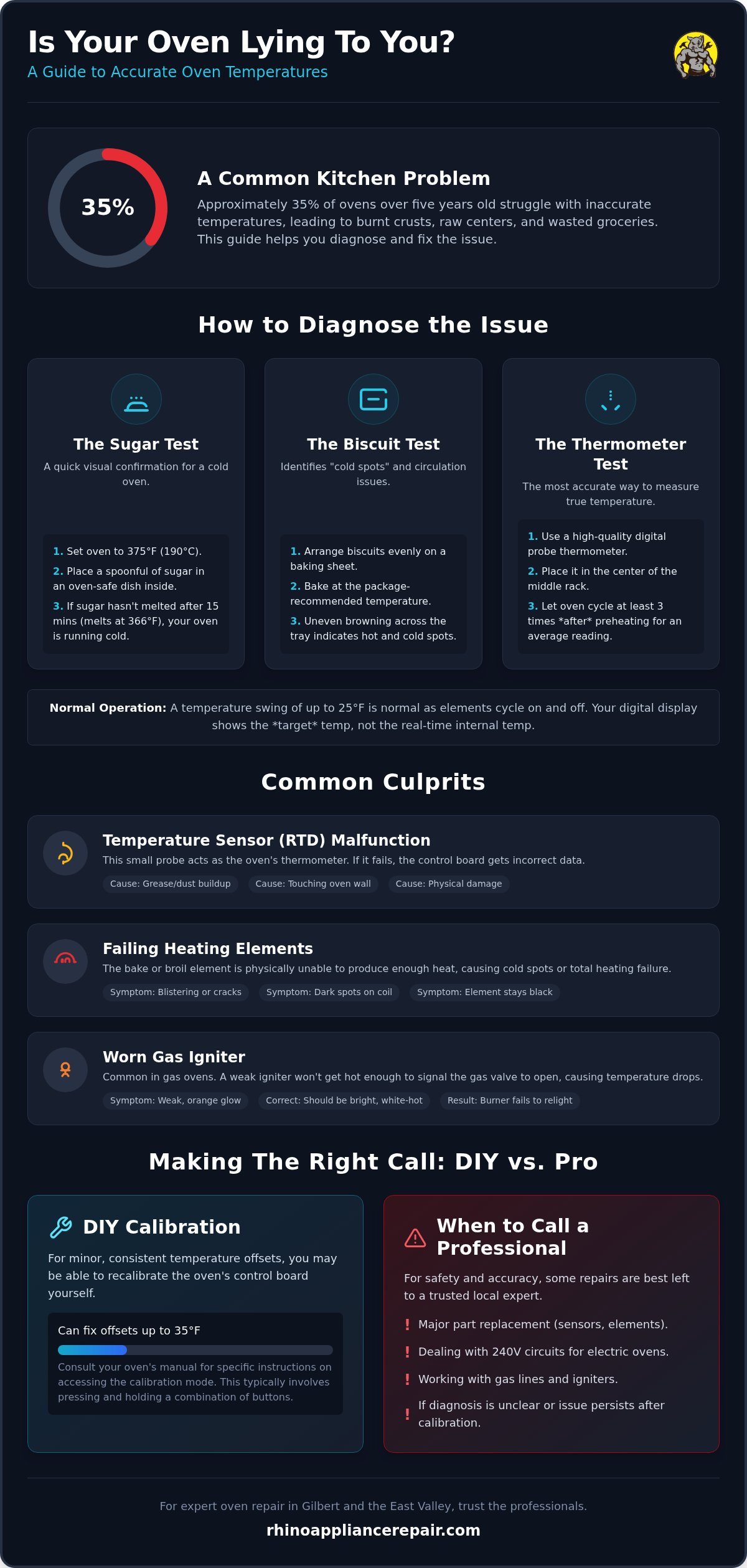
Is your dinner taking 20 minutes longer than the recipe suggests? You might need an oven temperature not accurate repair. It’s vital to distinguish between an oven that’s running a little cool and one that has failed entirely. A residential oven is a cycling machine; it doesn’t stay at exactly 350 degrees. It swings above and below that target as the heating elements click on and off. A variance of 25 degrees is usually considered normal operation. However, if your roast is consistently raw or your cookies are charred, you’re likely facing a mechanical issue rather than a simple quirk.
Try the sugar test for a quick visual confirmation. Place a spoonful of white sugar in an oven-safe dish and set the temperature to 375 degrees Fahrenheit. Sugar melts at exactly 366 degrees. If the sugar remains granulated after 15 minutes at a 375-degree setting, your oven is running significantly cold. The biscuit test is another effective method. Arrange store-bought biscuits across a baking sheet and bake them at the package temperature. Uneven browning across the tray identifies specific “cold spots” where air isn’t circulating or elements are failing.
Your digital display is often the least reliable tool in your kitchen. It shows what the control board thinks the temperature is, not the actual reality inside the cavity. Understanding What is an oven thermostat? helps clarify how these components can drift or fail over time. External probes provide the ground truth that built-in sensors often miss.
The Thermometer Test: Getting an Accurate Reading
Don’t rely on a cheap grocery store dial thermometer. They are often just as inaccurate as the oven you’re trying to test. Invest in a high-quality digital probe or a professional-grade stainless steel thermometer. Place the thermometer in the dead center of the middle rack. This position ensures you’re measuring the core cooking area where airflow is most consistent. Most importantly, don’t check the reading immediately after the preheat chime. Let the oven cycle on and off at least three times. This allows the heat to saturate the oven walls and provides a true average temperature reading.
Oven Not Heating vs. Inaccurate Temperature
A total heating failure is usually easy to spot. If you turn on the bake setting and the bottom element remains cold and black, the part is likely dead. In gas ovens, pay close attention to the igniter. A flickering or weak orange glow instead of a bright, white-hot light means the gas valve won’t open consistently. This causes massive temperature drops during the cooking cycle because the burner fails to relight. A faulty sensor sends incorrect data to the control board, while a broken element physically cannot produce the heat required to reach the target.
Common Culprits: Why Your Oven Temp Is Falling Short
Identifying the root cause of temperature swings is the first step toward a successful oven temperature not accurate repair. In the East Valley, our appliances face unique challenges. High levels of desert dust can coat sensitive components, while monsoon-season power surges often stress delicate circuitry. Understanding how these parts interact helps you pinpoint why your soufflé is falling or your roast is unevenly cooked.
The Temperature Sensor (RTD) Malfunction
The Resistance Temperature Detector (RTD) is a small probe that acts as the oven’s thermometer. It works by changing its electrical resistance based on the heat inside the cavity. If this sensor is caked in grease or heavy dust, it can’t read the air temperature correctly. Sometimes, the fix is as simple as a visual inspection. Check if the probe has been bumped and is touching the oven wall; this causes it to read the metal’s temperature instead of the air. Sensors are a frequent oven not heating repair point for Gilbert and Mesa residents. If the sensor is physically damaged or out of its specific resistance range, the control board will receive incorrect data, leading to inconsistent results.
Heating Elements and Igniters
Your oven relies on one or more elements to maintain heat. If you notice “cold spots,” your bake or broil element might be failing. Look for physical signs of trouble like blistering, cracks, or dark spots on the metal coils. These indicate the internal wiring is breaking down. In gas ranges, the igniter is often the silent culprit. A worn igniter might still glow bright orange, but it may lack the electrical “amps” required to signal the gas valve to open. This results in the burner failing to relight during the cycle, causing the temperature to plummet. Modern ranges also use convection fans to distribute heat. If that fan is sluggish or blocked by debris, you’ll experience significant temperature variances across different rack levels.
Don’t overlook the door gasket. This braided seal keeps the heat where it belongs. If it’s frayed or brittle, heat escapes constantly. This forces the oven to work harder and cycle more frequently, which eventually wears out the control board. This cycle of stress is why many homeowners eventually need an oven temperature not accurate repair to restore efficiency. If you’ve checked these parts and still have issues, it might be time to consult a local appliance specialist to test the control board’s logic circuits. Homeowners who also cook on electric stovetops should be aware that similar heating element failures can affect their cooktop; our guide to electric cooktop repair Gilbert AZ covers how to diagnose and address those issues as well.
How to Calibrate Your Oven for Consistent Results
Calibration is the fine-tuning process that aligns your oven’s “brain” with the actual heat inside the cavity. It’s a common DIY step before seeking a professional oven temperature not accurate repair. This feature is intended for minor adjustments, usually within a range of plus or minus 35 degrees Fahrenheit. If your oven is off by 50 or 100 degrees, calibration won’t help. That level of variance signals a failing component, like the RTD sensor or a weak igniter. Use this process only when your external thermometer shows a consistent, small gap between the setting and the reality.
Calibrating Digital Control Boards
Most modern ranges make this easy through the touch panel. Navigate to the “Settings” or “Options” menu and look for “Oven Offset” or “Calibration.” If you have an older digital model without a dedicated menu button, try holding the “Bake” and “Broil” buttons simultaneously for several seconds. A “00” should appear on the display. Use the arrow keys or number pad to add or subtract the degrees needed to match your external thermometer’s readings. It’s helpful to know that these calibration settings are saved in the control board’s memory even during power outages. You won’t have to redo this process after a summer monsoon knocks out the power.
Adjusting Analog Temperature Knobs
Analog knobs are just as adjustable, though the process is mechanical rather than digital. Pull the temperature knob straight off the control panel shaft. Flip it over to find a small adjustment screw or a movable plate on the back. You’ll often see markings or arrows pointing toward “Cooler” or “Hotter.” Use the “one-click” rule: move the dial one notch at a time. Each notch typically represents a 10-degree shift in the baseline temperature. Tighten the screw, replace the knob, and run a test bake. A fresh batch of simple sugar cookies is a great way to verify even browning across the middle rack.
Never use calibration to compensate for a part that’s clearly dying. If you find yourself constantly adjusting the offset every few months, the control board or sensor is likely failing. Over-calibrating can lead to unpredictable heat spikes that might damage your appliance or ruin your dinner. Precision is the goal here; it’s not a temporary bandage for a broken machine. If the 35-degree limit doesn’t solve the problem, it’s time to look at a professional repair. Homeowners dealing with persistent issues should also review our range repair East Valley AZ guide to understand when a full appliance evaluation makes more sense than repeated calibration attempts.
Troubleshooting vs. Professional Repair: Making the Right Call
Deciding whether to tackle an oven temperature not accurate repair yourself or call a pro is a matter of safety and efficiency. While some fixes are straightforward, others involve high-voltage electricity or volatile gas lines. Professionals use specialized tools like multimeters and thermal probes to pinpoint the exact failure. This diagnostic precision prevents the “parts cannon” approach, where homeowners waste money replacing perfectly good sensors or elements trying to guess the problem. Professional diagnostics ensure the job is done right the first time without unnecessary spending.
Modern appliances are increasingly complex. Some control board swaps require specialized programming that isn’t available to the general public. Attempting to bypass these steps can lead to a non-functional unit or even a fire hazard. A trusted local expert has the training to handle 240V electric circuits and gas connections with the proper precautions. Investing in a professional fix often pays for itself by extending the life of your appliance and preventing future breakdowns.
When DIY Is Safe (and When It Is Not)
Cleaning a dusty RTD sensor or replacing a brittle door gasket are excellent weekend projects. These tasks don’t require opening the internal housing or touching live wires. Minor calibration via the control board, as we discussed earlier, is also perfectly safe for most homeowners. However, replacing a gas igniter or testing a live circuit is where the risk outweighs the reward. One slip with a screwdriver can cause a short or a dangerous gas leak. It’s helpful to remember that dryer not heating repair follows similar safety rules regarding high voltage and fire hazards. If the repair requires opening the back of the unit, it is time to stop and call for help.
The Repair vs. Replace Decision Matrix
How do you know when your oven is a lost cause? We recommend the 50% rule. If the estimated cost for an oven temperature not accurate repair exceeds half the price of a brand-new unit, it’s usually time to shop for a replacement. The age of the appliance is the other major factor. Most residential ovens have a lifespan of about 12 to 15 years. If your unit is over 10 years old, parts often become discontinued or prohibitively expensive. Rhino Appliance Repair helps East Valley homeowners navigate these tough choices every day. We provide an honest, transparent assessment of your unit’s health during every service call. We won’t recommend a costly repair if a new oven is the better long-term investment for your home. Before making a final decision, it’s worth consulting our expert range repair East Valley AZ homeowner’s guide to weigh repair costs against replacement value with confidence. If you are ready for a clear answer on your appliance’s health, schedule a professional diagnostic with our team today.
Expert Oven Repair Services in Gilbert and the East Valley
Rhino Appliance Repair is your local, family-owned solution for all kitchen appliance troubles. We focus exclusively on residential service. This means our technicians aren’t distracted by commercial walk-ins or industrial equipment. We specialize in the major residential brands you actually have in your home. Our service area covers the entire East Valley, including Gilbert, Chandler, Mesa, Tempe, Queen Creek, and San Tan Valley. When you need an oven temperature not accurate repair, you want a professional who lives and works in your community.
We understand the local Arizona environment. Desert dust and seasonal power surges take a toll on sensitive RTD sensors and control boards. We’ve seen these issues hundreds of times across the valley. Our commitment to you is simple. We provide fast response times, friendly service, and completely transparent pricing. You’ll never have to worry about hidden fees or corporate jargon when we’re in your kitchen.
Why East Valley Homeowners Trust Rhino
We take a “Good Neighbor” approach to every service call. This isn’t just about turning a wrench; it’s about providing honest advice you can trust. We treat your kitchen like our own. If your oven is failing right before a big family dinner or a holiday gathering, we prioritize your crisis. We know that the heart of the home is the kitchen. A broken oven isn’t just an inconvenience; it’s a disruption to your family life. Our team carries the right tools and common parts to get your temperature back to precise levels quickly.
Schedule Your Oven Diagnostic Today
Booking a service call in Mesa or Chandler is fast and straightforward. When you schedule a visit, our technician arrives ready to perform a comprehensive diagnostic. We don’t just guess. We use professional-grade thermal probes and multimeters to verify your oven’s performance. During a professional oven temperature calibration visit, we test the heating elements, check the sensor’s resistance, and inspect the door seals for heat leaks. We leave nothing to chance.
We’ll give you a clear, upfront explanation of what’s wrong and what it costs to fix. If your oven is too old to repair safely, we’ll tell you that too. Our goal is to restore the heart of your kitchen so you can cook with confidence again. Don’t let a drifting thermostat ruin another meal. Contact Rhino Appliance Repair today to schedule your expert diagnostic and restore your oven with a reliable repair.
Get Your Kitchen Back to Precision Cooking
We’ve covered how to spot the difference between a simple calibration drift and a failing mechanical component. You now know that while a 35-degree adjustment can often be handled at home, larger swings usually point to a worn-out sensor, a weak igniter, or a damaged heating element. Precision is the goal for any successful home chef. If your troubleshooting reveals a more complex issue, don’t risk your safety or your next meal on a DIY oven temperature not accurate repair. Handling 240V circuits and gas lines requires professional expertise to keep your home safe.
Rhino Appliance Repair is a family-owned local business dedicated to helping our neighbors in Gilbert, Mesa, and Chandler. We provide expert residential service and fast responses for kitchen appliance emergencies. Our technicians focus on transparency and honesty, ensuring you only pay for the repairs you actually need. Schedule Your Oven Repair in the East Valley Today to ensure your appliance is perfectly calibrated and safe for your family. You deserve an oven that works as hard as you do. Let’s get those dinners back on track and restore your confidence in the kitchen.
Frequently Asked Questions
How do I know if my oven sensor is bad?
A failing sensor often triggers specific error codes like “F10” or “F3” on your digital display. You can also test the part with a multimeter to check its resistance; most sensors should read approximately 1080 ohms at room temperature. If the probe is physically touching the oven wall or appears visibly bent, it will send incorrect data to the control board. This causes the oven to cycle off too early or too late.
Can I calibrate my oven temperature myself?
Most modern digital ovens allow you to adjust the temperature offset by up to 35 degrees through the settings menu. You should first verify the actual heat with a high-quality external thermometer placed in the center of the middle rack. If the variance is larger than 35 degrees, a simple adjustment won’t solve the problem. In those cases, you likely need a professional oven temperature not accurate repair to replace a failing component.
Why does my oven take so long to preheat?
Slow preheating is typically caused by a partially failed heating element or a weak gas igniter. In electric models, if the bake element burns out, the oven tries to reach the target temperature using only the broil element, which takes much longer. For gas ovens, an aging igniter may take several minutes to reach the temperature required to open the gas valve safely. This delay significantly extends your total cooking time.
How much does it cost to repair an inaccurate oven temperature?
While the exact cost depends on the part required, industry averages for professional oven repairs generally fall between $130 and $310. Replacing a simple sensor is usually on the lower end of that scale, while a new control board will be more expensive. Most homeowners find that a diagnostic fee is a wise investment because it prevents the waste of money on unnecessary parts. This ensures a fast and accurate fix.
Is it worth repairing a 10-year-old oven?
Repairing a decade-old oven is usually worth it if the rest of the unit is in good condition and the fix is minor. However, if the repair cost exceeds 50% of the price of a new appliance, replacement is often the better long-term choice. Since most residential ovens have a lifespan of 12 to 15 years, a 10-year-old unit is nearing the end of its reliable service life and may face part availability issues.
What is the most common reason an oven temperature is not accurate?
A faulty temperature sensor is the primary culprit in about 40% of all oven temperature service calls. This small probe is highly sensitive to grease buildup and physical damage from sliding racks. Other frequent causes include worn heating elements or failing gas igniters that don’t stay lit. Identifying these issues early ensures your oven temperature not accurate repair is targeted and effective, preventing further frustration and wasted groceries in your kitchen.
Can a dirty oven affect the temperature accuracy?
Heavy grease and carbon buildup can insulate the temperature sensor and prevent it from reading the air temperature correctly. If the probe is coated in grime, it may take longer to register heat, leading to significant temperature overshoots. Spills on the floor of the oven can also block heat from the bake element or interfere with proper airflow. Keeping your appliance clean is a simple way to maintain its factory calibration and efficiency.
Do you provide oven repair in San Tan Valley and Queen Creek?
We proudly serve the entire East Valley, including both San Tan Valley and Queen Creek. Our family-owned team lives and works in these local communities, providing fast and reliable service to our neighbors. We specialize exclusively in residential kitchen appliances and understand the specific needs of Arizona homeowners. Whether you are in Chandler, Mesa, or Tempe, our technicians are ready to restore your oven’s performance with transparent pricing and professional expertise.



[881839]supplies professional anti-violence equipments and solutions for the whole world with strong and perfect production capacity. anti-violence.org
Pingback: Electric Cooktop Repair in Gilbert AZ: A Homeowner’s Troubleshooting Guide
Pingback: Why Your Gas Stove Flame Is Yellow: Causes, Risks, and Fast Fixes – rhinoappliancerepair.com
Pingback: Average Cost of Appliance Repair: 2026 Homeowner’s Price Guide – rhinoappliancerepair.com
Pingback: Expert Wolf Cooktop Repair Service in Gilbert AZ | Fast Local Help – rhinoappliancerepair.com