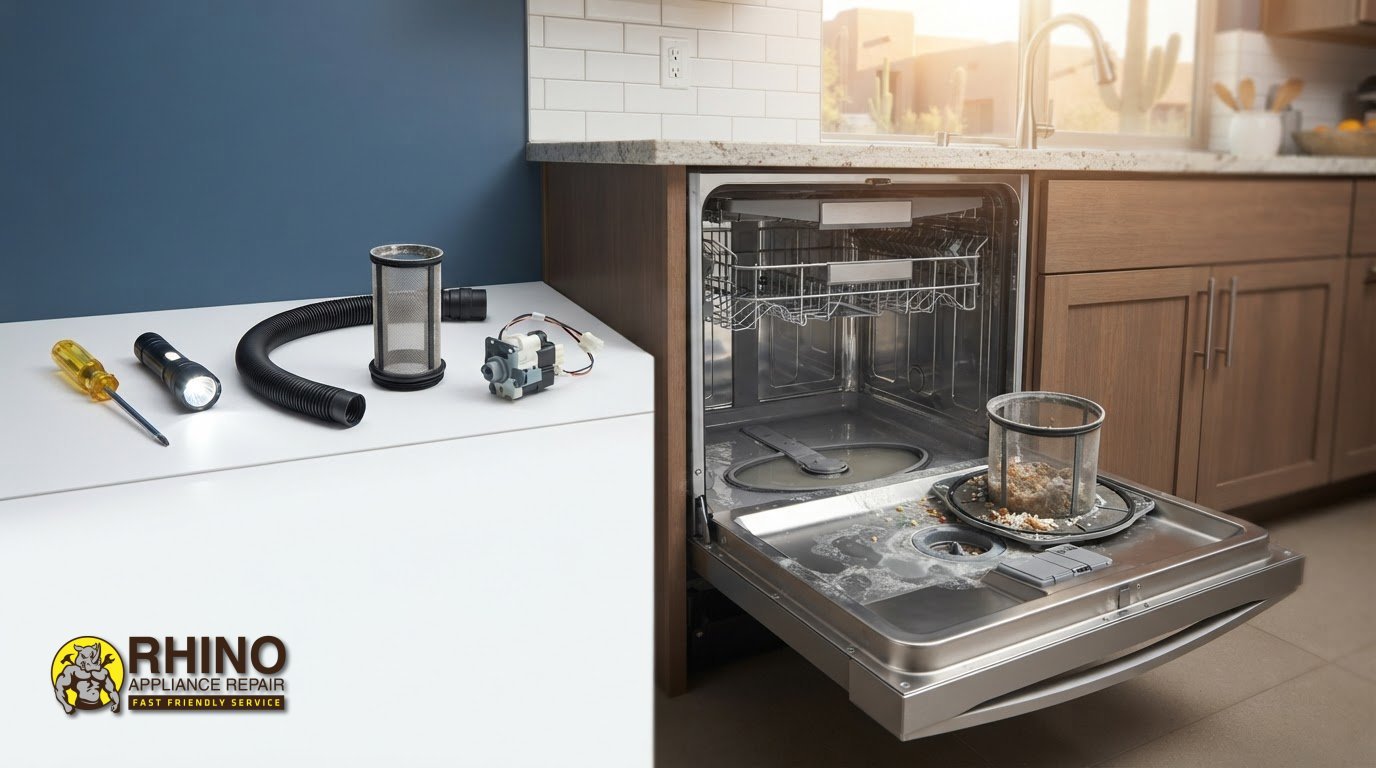
You open your dishwasher expecting clean, dry plates, but instead, you’re met with a pool of murky, gray water sitting at the bottom of the tub. It’s a frustrating sight that usually means a long night of hand-washing and a kitchen that smells like old leftovers. When you’re facing a dishwasher not draining repair, the fear of water damage to your East Valley home’s floors can be just as stressful as the pile of dirty dishes in the sink.
We understand the urgency of getting your kitchen back in order. Most drainage issues aren’t catastrophic mechanical failures. Often, the culprit is a simple blockage caused by food scraps or the heavy mineral buildup common in Gilbert and Mesa tap water. We’ll help you identify exactly why your unit is holding onto water and show you how to safely troubleshoot the most common clogs before the mess gets worse.
This guide provides a clear look at where clogs hide, from the fine mesh filters to the sink air gap. You’ll learn how to inspect your drain hose and pump without the guesswork. By the end, you’ll have a functioning dishwasher that drains completely and a clear understanding of when it’s safe to DIY versus when you should call an experienced local expert for help.
Key Takeaways
- Learn to identify the specific symptoms of drainage failure, from murky standing water to slow-clearing cycles that leave behind unpleasant odors.
- Discover how to perform simple homeowner checks on your garbage disposal and air gap to potentially fix a dishwasher not draining repair on your own.
- Understand how Arizona’s hard water and mineral deposits can clog filters and seize critical components like the drain pump impeller.
- Recognize when technical issues like a failed motor or a blocked corrugated hose require the specialized tools of a residential repair expert.
- Gain clarity on the repair-versus-replace debate to help you make the most practical decision for your kitchen and your household needs.
Identifying Common Symptoms of Dishwasher Drainage Problems
Identifying the signs of a drainage issue is the first step toward a solution. It isn’t always a massive flood. Sometimes, it’s just a lingering puddle or a strange sound that hints at a deeper problem. Recognizing these symptoms early can prevent water damage to your kitchen cabinets and floors. If you’re searching for a dishwasher not draining repair, you’ve likely noticed one of these common red flags.
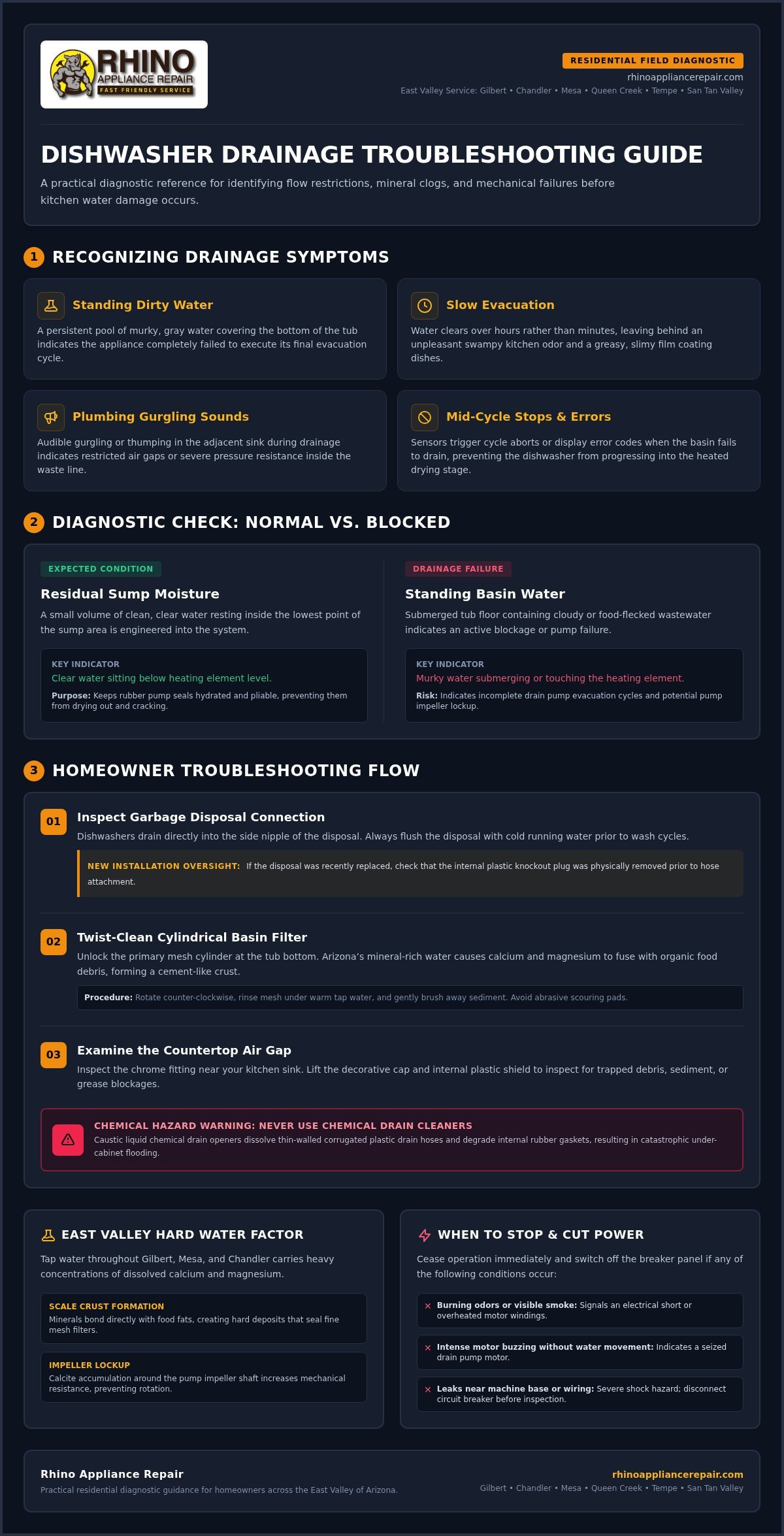
- Standing water: This is the most obvious sign. If you open the door and see a pool of dirty, gray water covering the bottom of the tub, the machine failed to complete its final drain phase.
- Slow draining: This symptom is more subtle. You might notice that the water eventually leaves, but it takes hours. This often leaves a layer of slimy residue on your plates or a swampy odor in the kitchen.
- Gurgling sounds: Unusual noises often signal a fight for space in your drain lines. If your sink starts “talking” to you while the dishwasher runs, there’s likely a restriction in the plumbing or the air gap.
- Cycle interruptions: Modern dishwashers have sensors that detect when water hasn’t evacuated. The machine might stop mid-wash or display an error code, refusing to move to the drying stage until the basin is clear.
Standing Water vs. Residual Moisture
Knowing the difference between normal moisture and a true clog saves time. It’s actually normal to see a small amount of clear water in the sump area at the very bottom. This moisture keeps the pump seals from drying out and cracking. However, if the water covers the heating element or looks murky with food particles, you have a blockage. Understanding how dishwasher drainage cycles operate can help you distinguish between a standard cycle finish and a mechanical failure. In a healthy cycle, the pump should forcefully push water out several times before the drying phase begins. If that water stays put, it’s time for a dishwasher not draining repair diagnostic.
When to Stop and Call a Professional
While many clogs are simple to clear, some symptoms indicate a serious safety hazard. If you notice a burning odor, see smoke, or hear an intense buzzing sound without any water movement, stop the cycle immediately. These are signs of a seized motor or an electrical short. Water leaking near the base of the machine where the motor and wiring live is also a major concern. If you see water pooling near electrical outlets or the junction box, shut off the power at the circuit breaker. In these cases, seeking a professional diagnostic from Rhino Appliance Repair is the safest way to prevent further damage or injury.
Homeowner Troubleshooting: Simple Checks to Clear a Drain
Before you assume your pump has died, start with the simplest external factors. Many calls for a dishwasher not draining repair in cities like Chandler and Gilbert end up being issues with the surrounding plumbing rather than the appliance itself. These checks take only a few minutes and require no special tools. Clearing a simple blockage now can prevent the need for a more involved mechanical fix later.
The Garbage Disposal Connection
Your dishwasher and garbage disposal are teammates. The dishwasher typically drains through a small hose connected directly to the disposal’s side. If the disposal is packed with food debris, it acts like a cork in a bottle. Always run your disposal with cold water before starting a dishwasher cycle to ensure the path is clear. If you recently replaced your disposal, check the dishwasher inlet nipple. Manufacturers include a plastic knockout plug that must be removed during installation. If it’s still there, your dishwasher will never drain. It’s a common oversight we see during residential service calls across the East Valley.
Cleaning the Dishwasher Filter
The filter at the bottom of the tub is the first line of defense. Over time, it traps everything from lemon seeds to plastic labels. In our desert environment, our water is notoriously heavy with minerals. According to USGS water hardness guidelines, high concentrations of calcium and magnesium can cause scale to bond with food particles. This creates a cement-like crust on your mesh filter that blocks water flow. Twist the cylindrical filter out and rinse it under warm tap water. Avoid using caustic chemical drain openers. These harsh liquids can melt corrugated plastic hoses and ruin rubber seals, turning a simple clog into an expensive leak.
Next, look at the air gap. That chrome cylinder on your sink prevents dirty sink water from siphoning back into the dishwasher. Pop the decorative cover off and check for a buildup of grease or small bits of food. Finally, peek under the sink. Ensure the drain hose isn’t kinked or pinched by heavy stacks of cleaning supplies or a stray trash can. If you’ve tried these steps and the water still won’t move, you may need a professional diagnostic to check the internal pump or check valves.
Mechanical and Technical Causes for Draining Failures
When simple homeowner checks like cleaning the filter or clearing the disposal don’t solve the problem, the issue is likely internal. Mechanical failures require a more technical look at the components that drive the drainage process. If your unit is still struggling, a dishwasher not draining repair often involves inspecting the pump, the drain hose, or the electrical signals that tell the machine what to do next. Internal clogs or worn-out parts can stop a cycle in its tracks.
Inspecting the Drain Hose
The drain hose is a long, corrugated plastic tube that carries wastewater from the pump to your sink’s plumbing. Because the interior is ribbed, it’s easy for small food particles, grease, and debris to get caught in the ridges. Over time, these small bits form a solid plug. This often happens at the “high loop,” which is the highest point where the hose is fastened under your counter. If the hose is collapsed, cracked, or improperly installed, the pump won’t have the strength to push water through the restriction. We often find that a single drainage symptom is actually caused by a combination of a partially blocked hose and a struggling motor.
Understanding the Drain Pump
The drain pump is the heart of the evacuation process. It uses a small motor and a spinning impeller to force water out of the basin. If you hear a loud humming or buzzing sound but the water isn’t moving, the motor might be seized. Small foreign objects like toothpicks, fruit pits, or shards of broken glass can bypass the filter and jam the impeller blades. If the blades are broken or the motor windings have failed, the pump will need to be replaced. When evaluating if a mechanical fix is worth the investment, many homeowners compare the efficiency of their current unit against ENERGY STAR certified dishwasher standards to see if a newer, high-efficiency model makes more sense.
Two other technical culprits include the check valve and the control board. The check valve is a small rubber flap that only allows water to flow in one direction. If it gets stuck in the closed position, water stays in the tub. If it’s stuck open, dirty water from the sink can siphon back into the dishwasher. Less commonly, the main control board may fail to send the electrical signal to start the drain pump. If you notice burning odors or see scorched wiring near the base of the machine, stop using the appliance immediately. Electrical faults are serious hazards that require a professional diagnostic from an experienced technician to ensure your home stays safe.
Arizona Hard Water and Your Dishwasher Drain
Living in the East Valley means dealing with some of the hardest water in the country. This environmental factor is a primary driver for many dishwasher not draining repair calls in our community. While mechanical parts eventually wear out, the high mineral content in our local supply often accelerates that process. If you’ve noticed a white, chalky film on your glassware, your drainage system is likely struggling with the same buildup behind the scenes.
Calcium and Magnesium Deposits in the East Valley
The water in Gilbert, Mesa, and Chandler is notoriously heavy with minerals. In Mesa, water hardness can range from 12 to 22 grains per gallon (gpg). Gilbert reports averages between 8 and 12.9 gpg. Since the federal standard classifies anything over 10.5 gpg as “Very Hard,” most East Valley homes are well into the top tier of mineral-heavy water. These minerals don’t just disappear during a wash cycle. In the high-heat environment of a dishwasher, calcium and magnesium precipitate out and form a hard scale.
This scale acts like a slow-moving clog. It coats the interior of your corrugated drain hose, narrowing its diameter over time. A hose that once moved water freely can become restricted, forcing the pump to work twice as hard. This mineral crust also attacks the check valve. This small rubber flap needs to be flexible to prevent dirty sink water from siphoning back into your machine. Hard water causes the rubber to stiffen and crack. When the valve can’t seal, you’ll find “mystery water” pooling in your tub hours after a cycle ends.
Arizona’s desert dust also plays a role. Fine silt and grit often find their way into our homes during monsoon season. When this dust combines with cooking oils and soap residue, it creates a thick, heavy sludge. This mixture is much harder for a standard drain pump to evacuate than simple soapy water, often leading to premature motor failure.
Preventing Buildup in Your Dishwasher
You can fight back against mineral scaling without using dangerous chemicals. Citric acid-based cleaners are highly effective at safely dissolving calcium deposits without damaging your rubber seals or plastic hoses. Running a monthly cleaning cycle helps keep the drain pump impeller and check valve moving freely. Using high-quality detergents with built-in water softeners also helps keep minerals suspended in the water so they can be pumped out rather than bonding to your appliance parts. If your machine is already struggling with heavy scaling or a seized pump, you can schedule an expert mineral descaling and repair to restore your drainage system’s efficiency.
Professional Repair vs. Replacement for Dishwashers
Deciding whether to invest in a dishwasher not draining repair or buy a new machine is a common dilemma. Many big-box retailers suggest that appliances are disposable. However, a high-quality residential dishwasher is a significant investment. In many cases, a machine that won’t drain is suffering from a single failed part rather than a total system collapse. Replacing a drain pump or a check valve is often far more practical than the cost and hassle of installing a brand-new unit.
Age is a factor, but it isn’t the only one. If your dishwasher is otherwise in good condition and matches your kitchen suite, a professional repair can extend its life by several years. We often see homeowners choose to repair high-end brands like Bosch, Samsung, or KitchenAid because the build quality remains superior to many entry-level models found today. If the body of the machine is free of rust and the racks are in good shape, a mechanical fix is usually the smartest financial move.
Why Choose Professional Diagnostics?
One of the biggest mistakes homeowners make is the “parts cannon” approach. This involves buying and installing various parts based on internet guesses without a firm diagnosis. You might spend money on a new pump only to find the issue was actually a restricted drain hose or a faulty control board signal. A professional diagnostic identifies the root cause quickly. This saves you from wasting money on components you don’t actually need. Our experience with East Valley water conditions allows us to spot mineral-related failures that generic guides often overlook. Safety is also a priority. Dealing with water leaks near electrical motors requires a trained eye to ensure your appliance is safe for daily use.
Preparing for a Service Visit
To make your service appointment as efficient as possible, there are a few simple steps you can take. Clear the area around the dishwasher and the cabinet space under your kitchen sink. This gives the technician immediate access to the drain lines and electrical connections. It’s also helpful to note exactly when the failure occurs. Does the water stay in the tub at the very end of the cycle, or does it stop mid-wash? Knowing these details helps narrow down the cause faster. When you are ready for expert residential service, contact Rhino Appliance Repair. We focus on providing honest, practical solutions for homeowners in Gilbert, Chandler, Mesa, and throughout the East Valley.
Restoring Your Kitchen’s Efficiency
Dealing with standing water doesn’t have to mean a total kitchen meltdown. Most drainage issues stem from simple blockages or the heavy mineral scaling common in our East Valley water supply. By checking your filters, garbage disposal, and air gap, you can often resolve minor clogs on your own. However, when the problem involves a seized motor or an electrical fault, professional expertise is necessary to ensure a safe and lasting fix.
Choosing a repair over a full replacement is often the most practical choice for major brands like LG, Samsung, and Bosch. A precise diagnostic prevents you from wasting money on unnecessary parts and gets your appliance back into top shape quickly. As a locally owned and operated team, we take pride in providing reliable residential service to our neighbors throughout Gilbert, Chandler, and Mesa.
Schedule your professional dishwasher repair with Rhino Appliance Repair to get your kitchen back on track. We are here to help you navigate your dishwasher not draining repair with honest advice and experienced craftsmanship. You’ll be back to a clean, dry kitchen and a functioning home in no time.
Frequently Asked Questions
Is it safe to leave standing water in my dishwasher overnight?
It is generally not safe to leave dirty standing water in your dishwasher for long periods. Stagnant water quickly becomes a breeding ground for bacteria and mold, which leads to foul odors. If the water is deep enough to reach the door seals, it might cause slow leaks. If you notice water pooling near electrical junctions or the motor, shut off the power at the circuit breaker immediately and seek professional help.
Why does my dishwasher smell like rotten eggs when it won’t drain?
A rotten egg smell usually indicates that food particles are decomposing in stagnant water at the bottom of the tub. When the machine doesn’t drain, these organic materials rot, releasing sulfur gases. This is a common sign you need a dishwasher not draining repair. You should check the cylindrical filter and the sump area for trapped debris like meat scraps or vegetable skins that are causing the stench.
Can a clogged sink cause my dishwasher not to drain?
Yes, a clogged kitchen sink is a frequent cause of drainage failure. Most dishwashers connect to the sink’s drain pipe or the garbage disposal. If your sink is backed up, the wastewater from the dishwasher has nowhere to go and will stay in the tub. Always ensure your sink and disposal are clear before starting a wash cycle to allow for proper water evacuation through the shared plumbing.
Should I use Drano or liquid plumber in my dishwasher?
You should never use caustic chemical drain cleaners like Drano or Liquid-Plumr inside a dishwasher. These chemicals are designed for sturdy PVC or metal pipes, not the delicate rubber seals and plastic components of an appliance. They can melt the corrugated drain hose and destroy the pump’s internal gaskets. Instead, stick to manual cleaning of the filter or use mild, citric acid-based cleaners to safely dissolve mineral scale.
How do I know if my dishwasher drain pump is bad?
You can tell a drain pump is failing if the machine makes a loud humming sound during the drain phase but no water moves. This suggests the motor is trying to run but the impeller is jammed or the motor windings have failed. If you see an error code on the display related to drainage, it’s a strong indicator that a professional dishwasher not draining repair is needed to test the pump’s electrical continuity.
What is a dishwasher air gap and how do I clean it?
An air gap is the small chrome or plastic cylinder located on your sink deck. It prevents dirty sink water from siphoning back into your dishwasher. To clean it, pull the decorative cover straight up and unscrew the inner plastic cap. Look for trapped food solids, grease, or small plastic ties that might be blocking the flow. Clearing these obstructions often restores drainage immediately without needing tools or professional help.
How often should I clean my dishwasher filter in Arizona?
In the East Valley, you should clean your dishwasher filter at least once a month. Arizona’s hard water contains high levels of calcium and magnesium, which create mineral scale on the fine mesh. This scale traps food particles more easily than a clean filter would. Regular maintenance in Gilbert and Mesa homes prevents the pump from straining and helps avoid the need for more frequent mechanical repairs caused by restricted water flow.
Why is my dishwasher suddenly making a loud humming noise?
A sudden humming noise usually means the drain pump motor is energized but cannot spin. This happens when a foreign object like a cherry pit, toothpick, or shard of glass gets stuck in the impeller blades. If the noise is accompanied by a burning smell, it indicates the motor is overheating. Stop using the machine immediately and contact a qualified technician to inspect the pump for damage or electrical shorts.