
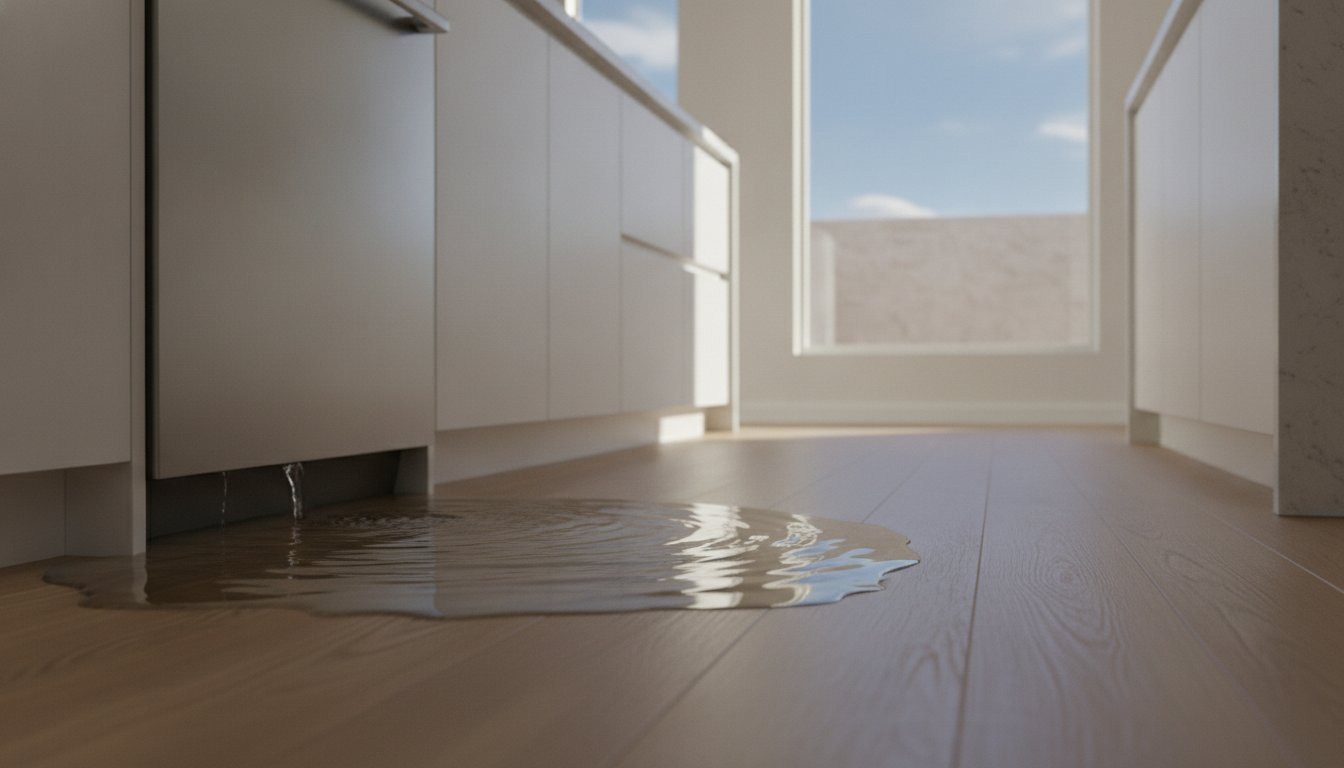
Imagine walking into your kitchen for a morning coffee and feeling a cold, swampy soak through your socks. That small puddle creeping from under your appliance isn’t just a mess. It’s a ticking clock for your expensive hardwood or laminate floors. We understand the panic. You don’t want to deal with the frustration of hand-washing every plate. You certainly don’t want to worry about hidden costs or permanent damage. Getting a handle on dishwasher leaking from bottom repair is the best way to regain your peace of mind and protect your home.
You’re likely wondering if this is a simple DIY fix or a sign that you need a new machine. In the East Valley, hard water buildup often strains these components. Identifying the source quickly is vital. This guide will teach you how to identify the exact cause of your dishwasher’s bottom-side leak. We’ll also explain when it’s time to call a professional. Our goal is to save your kitchen floors from a costly disaster. We’ll walk through the most common failure points like door seals, the tub, and the pump assembly. You’ll gain a clear understanding of the failed part and the confidence to choose a local repair expert who can get your kitchen dry again.
Key Takeaways
- Act fast to shut off the cycle and dry your floors to prevent permanent warping or cabinet damage.
- Inspect the door gasket and lower seal for debris or cracks that allow water to escape during the wash cycle.
- Remove the kickplate to inspect the pump and hoses, which helps you determine if a dishwasher leaking from bottom repair is a simple fix or a job for an expert.
- Discover how Arizona’s hard water and specific detergents can cause scale buildup and “oversudsing” leaks.
- Use the 50% rule to determine if a professional repair is a smart investment or if it’s time for a replacement.
Immediate Steps: What to Do When Your Dishwasher Leaks
Seeing water pool at the base of your appliance is an immediate emergency. Stop the cycle. Contain the water. Protect your home. If the machine is still running, it’s likely just pumping more water into the puddle. Your first priority is to stop the flow and minimize the damage to your kitchen. Before you dive into a dishwasher leaking from bottom repair, you must secure the area and ensure your own safety.
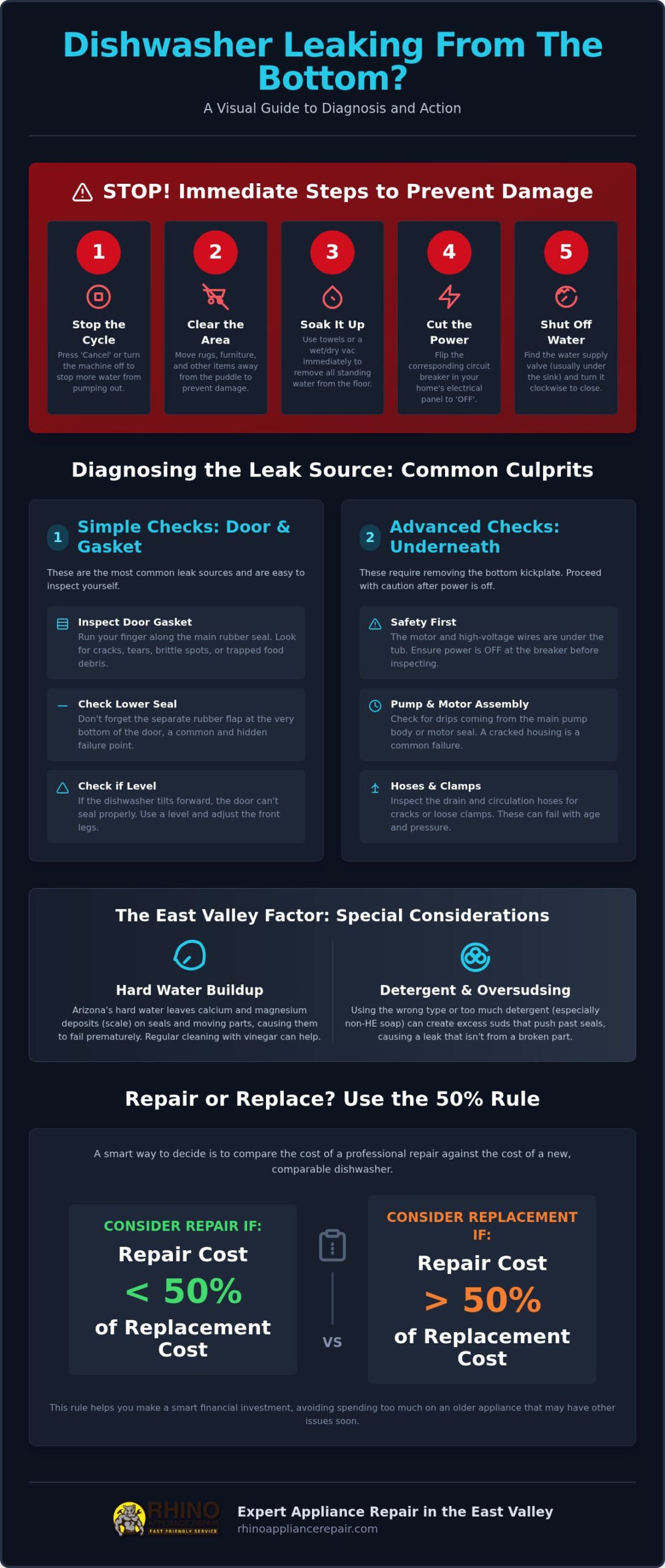
- Stop the cycle: Press the cancel button or turn the dial to the off position.
- Clear the area: Move any rugs, furniture, or kitchen items away from the puddle.
- Soak it up: Use towels or a wet/dry vac to remove standing water immediately.
- Cut the power: Flip the circuit breaker in your electrical panel to the “off” position.
- Shut off the water: Turn the supply valve under the sink clockwise until it stops.
Safety First: Electricity and Water
Bottom leaks are particularly dangerous. Most electrical components, like the drive motor and high-voltage wiring, sit directly underneath the tub. If you’ve been curious about how dishwashers work, you should know that water and electricity are only separated by a few inches of space in this area. Never touch the unit with wet hands if you are standing in a puddle. Go straight to your electrical panel. Look for the breaker labeled “Dishwasher” or “Kitchen” and flip it off. If your machine is a plug-in model and the outlet is dry, unplug it carefully. Once the power is dead, you can safely work around the unit without risk of shock. While the power is off, remove the kickplate at the bottom of the unit. This gives you a clear view of the internal components, allowing you to spot the exact drip point once you are ready to test the unit later.
Protecting Your Flooring
Time is your enemy here. Every minute water sits on your floor, the potential repair bill for your home grows. Tile floors are resilient, but the grout can still absorb dirty water and stain. Hardwood and laminate are the real concerns for East Valley homeowners. Hardwood floors can suffer from “cupping,” where the board edges warp upward as they absorb moisture. Laminate is even more sensitive; it’s often made of pressed wood that swells and stays that way once wet. It usually cannot be repaired and must be replaced. Use a wet/dry vac to pull up large puddles quickly. If you don’t have one, use old towels and rotate them as they become saturated. Once the surface is dry, point a high-powered fan toward the base of the machine. This circulates air into the subfloor area to prevent mold growth and rot. Taking these steps now makes the eventual dishwasher leaking from bottom repair much less stressful for your wallet and your kitchen.
Checking the Door Gasket and Lower Seal
The most common culprit for a puddle on your kitchen floor is a failing door seal. This rubber gasket runs along the perimeter of the tub, creating a watertight vacuum when the door is latched. Over time, heat and detergent wear down the rubber. Open your dishwasher and run your finger along the entire length of the gasket. You are looking for cracks, tears, or brittle spots. Even a tiny piece of trapped food debris, like a stray toothpick or a build-up of grease, can prevent the door from sealing completely. If you find debris, wipe it away with a damp cloth and test the unit again. This simple check is often the first step in a successful dishwasher leaking from bottom repair.
Don’t stop at the sides. Many homeowners overlook the lower door seal, which is a separate rubber flap at the very bottom of the door. Because it’s harder to see, it often hides tears that allow water to escape directly onto your floor. While you’re down there, check if your appliance is level. If the unit tilts forward or to one side, the door won’t seat flush against the tub. This creates a gap that even a brand-new gasket can’t close. Use a spirit level on the top frame of the tub and adjust the front legs until it’s perfectly straight.
Cleaning vs. Replacing the Gasket
In the East Valley, our hard water is a major factor in seal failure. Calcium and magnesium deposits create a white, crusty film on the rubber. This mineral buildup makes the gasket lose its elasticity, leading to “set” rubber that no longer bounces back to fill gaps. Before you buy a replacement part, try cleaning the seal with a warm vinegar solution. This dissolves the minerals and may restore the seal. You can perform the “dollar bill test” to check the integrity of the rubber. Close the door on a dollar bill; if you can pull it out with no resistance, the seal has lost its grip and needs replacement. If the rubber feels hard or shows visible cracks, scheduling a professional inspection is the safest way to prevent further floor damage.
The Role of the Spray Arm
Sometimes the leak isn’t caused by a bad seal, but by water being forced where it doesn’t belong. A cracked or clogged spray arm can cause a “wave” effect inside the tub. If the small holes in the plastic arm are blocked by mineral deposits or food particles, the water pressure can’t distribute evenly. This might result in a high-pressure jet of water spraying directly at the door seal rather than the dishes. The spray arm is designed to distribute water across the dishes while directing flow away from the sensitive door base. Check the arm for any splits in the plastic and ensure it spins freely without hitting any tall plates or fallen utensils. A blocked spray arm is a simple fix that often resolves mysterious bottom-side leaks.
Investigating the Pump, Motor, and Hoses
If the door seals look good, it’s time to look under the hood. You’ll need to remove the kickplate, also known as the toe kick. This is the panel at the very bottom of the unit. Usually, a few screws hold it in place. Once it’s off, grab a high-powered flashlight. You are looking for more than just active puddles. In our East Valley climate, hard water leaves a distinct “roadmap.” Look for white, crusty mineral trails or rust spots on the floor and components. These marks show you exactly where water has been traveling, even if the unit is currently dry. This is a critical step in any dishwasher leaking from bottom repair because it reveals hidden failures in the pump housing or hose connections.
- Check the pump housing: Look for drips around the plastic casing.
- Inspect hose clamps: Vibration can loosen the metal rings over time.
- Examine the inlet valve: Look for moisture where the main water line connects.
- Search for “salt trails”: White buildup indicates a slow, long-term leak.
The Main Pump and Seal
Your appliance uses two different pumps to get the job done. The circulation pump drives water through the spray arms, while the drain pump removes it. Most leaks occur at the pump seal, which sits around the motor shaft. If you see moisture or corrosion where the motor meets the pump, the seal has likely failed. This is a common point of wear. Interestingly, a washer won’t drain fix often requires a similar look at pump seals and motor shafts. If the pump housing is cracked or the seal is gone, a professional replacement is usually the only permanent solution.
Float Switch and Overfill Issues
Sometimes the leak isn’t a broken part, but a control failure. The float switch is a small plastic “mushroom” inside the tub. As water fills the machine, the float rises. Once it reaches a certain level, it tells the water inlet valve to shut off. If the float gets stuck on a piece of food or a fallen utensil, it can’t rise. This leads to an overfill situation where water spills over the tub’s edge. Reach inside and lift the float. It should move up and down freely with a light clicking sound. If the float moves but the tub still overfills, your water inlet valve might be stuck in the open position. This valve can fail due to the high mineral content in our local water, requiring a quick swap to stop the flooding.
The East Valley Factor: Hard Water and Detergent
Living in Gilbert or Mesa means dealing with some of the hardest water in the country. Water hardness in Mesa can reach up to 22 grains per gallon. These minerals don’t just leave spots on your glasses. They actively destroy the components that keep your kitchen dry. If you are struggling with a dishwasher leaking from bottom repair, the culprit might not be a broken mechanical part. It might be the water itself. High concentrations of calcium and magnesium create a chalky scale that interferes with every moving part and seal in your machine.
This mineral buildup is a constant battle for Arizona homeowners. It settles into the crevices of your appliance, slowly eating away at the integrity of the system. Understanding how our local environment affects your dishwasher is the first step toward a permanent fix. You can prevent many common leaks simply by changing how you maintain the unit and which products you put inside it.
Hard Water Scale on Gaskets
White mineral deposits are more than an eyesore. When scale builds up on your rubber door gaskets, it creates a rough, uneven surface. This prevents the door from forming a watertight seal. The rubber eventually loses its flexibility and becomes brittle. To fix this, use a soft brush and a warm vinegar solution to gently scrub the seals. Avoid harsh chemicals that can rot the rubber. We see these same mineral issues during our expert refrigerator repair in Gilbert AZ, where scale clogs water lines and ice makers. Regular maintenance is the only way to stay ahead of the Arizona mineral build-up.
The Danger of Excessive Suds
Sometimes a leak isn’t actually water. It’s foam. Using too much detergent or the wrong type creates “oversudsing.” These bubbles are light and can be pushed out through the bottom vents or the air gap by the internal pressure of the wash cycle. This looks exactly like a mechanical failure. If you see foam, don’t panic. You can clear the suds by pouring a tablespoon of vegetable oil or a handful of table salt into the bottom of the tub. This breaks the surface tension and kills the foam instantly. Always use high-efficiency (HE) detergents and follow the manufacturer’s recommended amounts to avoid this mess.
To keep your machine running smoothly, run a periodic descaling cycle using a commercial dishwasher cleaner. This removes the hidden scale inside the pump and hoses before it leads to a catastrophic failure. Using a quality rinse aid also helps water sheet off surfaces, preventing mineral spots from forming in the first place. If your machine continues to pool water despite these steps, it’s time for a professional look. You can book your dishwasher service online to stop the leak before it ruins your subfloor.
Professional Repair vs. Replacement in the East Valley
Deciding whether to invest in a dishwasher leaking from bottom repair or buy a brand-new machine is a common headache for homeowners. Most dishwashers have an average lifespan of 9 to 10 years. If your unit is approaching a decade of service, a major failure might be the first of many. However, for a relatively young machine, a professional repair is often the most sustainable and cost-effective choice. You’ll want to evaluate the age of your unit against the total cost of a new installation, which includes the price of the appliance plus the labor to hook it up. In Arizona, the high heat and hard water can accelerate wear on plastic components, making a professional opinion even more valuable before you spend hundreds on a replacement.
Use the “50% rule” as your primary guide. If the estimate for your dishwasher leaking from bottom repair exceeds half the price of a brand-new unit, replacement is usually the smarter financial move. Don’t forget that installing a new dishwasher involves labor costs between $150 and $350. Sometimes, a simple seal or a new water inlet valve is all that stands between you and a dry floor. Professional diagnosis removes the “part-changing” guesswork that often plagues DIY projects. We see many homeowners in Chandler and Queen Creek spend more on unnecessary parts than they would have on a single expert service call.
When DIY Isn’t Enough
Some issues go far beyond a simple gasket swap or cleaning out a spray arm. Complex repairs, such as replacing a seized circulation motor or fixing cracks in the main tub, require specialized tools and expert knowledge. These are high-stakes fixes. If a motor is installed incorrectly, it can lead to an electrical short or a much larger flood. If you’re struggling to decide if your appliance is worth the investment, check our appliance decision guide for help choosing between repair and replacement. A professional repair also provides a warranty on both labor and parts. This gives you long-term protection that a weekend DIY project simply cannot offer.
Fast Local Service with Rhino
Rhino Appliance Repair is a family-owned and operated team. We understand the urgency of a leaking appliance in a busy home. We’ve built our reputation on being a helpful, honest neighbor to the local community. Our technicians specialize in residential dishwasher service across the entire East Valley, including Gilbert, Chandler, Mesa, Tempe, and San Tan Valley. We move quickly from identifying your pain point to presenting a clear, effective solution. We take personal pride in our craftsmanship and aim to lower your stress levels during a kitchen crisis. Don’t let a small drip turn into a floor-warping disaster that ruins your cabinets. Contact Rhino for a professional dishwasher inspection today.
Protect Your Kitchen and Restore Your Peace of Mind
A leaking dishwasher doesn’t have to mean a ruined kitchen floor or a massive renovation bill. By acting fast and checking the door gaskets or pump housing, you can often stop water damage before it spreads into your subfloor. Remember that the unique hard water challenges in the East Valley require extra vigilance with descaling and seal maintenance. If the source of the drip remains a mystery or the repair feels too complex, don’t waste time on frustrating guesswork. A professional dishwasher leaking from bottom repair ensures the job is done right the first time with a reliable warranty.
Rhino Appliance Repair is your trusted local partner for fast, friendly help. We are a family-owned business with over 5 years of experience serving our neighbors. Our team provides expert residential service in Gilbert, Chandler, and Mesa. We are specialists in refrigerators, washers, dryers, and dishwashers. Schedule Your Dishwasher Repair with Rhino Appliance Repair Today to get your kitchen back in order. You don’t have to face a swampy kitchen alone. Let’s get those dishes clean and your floors bone-dry today.
Frequently Asked Questions
Is it worth repairing a dishwasher that is leaking from the bottom?
Yes, if the unit is under 9 years old and the repair cost is less than 50% of a new machine. Many bottom leaks are caused by simple issues like a loose hose clamp or a worn door seal. Fixing these small parts is much cheaper than buying and installing a new unit. However, if the tub is cracked or the main motor has failed on an older model, replacement might be the smarter financial choice.
Can a clogged filter cause my dishwasher to leak from the bottom?
Yes, a severely clogged filter can lead to a bottom leak. When the filter is blocked with food debris, water cannot drain quickly enough during the cycle. This causes the water level to rise higher than intended. Eventually, the excess water can slosh over the front lip of the tub or put pressure on the lower door seals. Cleaning your filter every month prevents this buildup and protects your kitchen floors from overflow.
How do I know if my dishwasher pump is leaking?
You can identify a pump leak by removing the lower kickplate and checking the motor area with a flashlight. Look for active drips or white, crusty mineral deposits around the pump housing. These salt trails are common in the East Valley and indicate a failing seal. If you see water pooling directly under the center of the machine where the motor sits, it is a clear sign you need a dishwasher leaking from bottom repair.
Why does my dishwasher leak only during the drain cycle?
Leaks that only occur during the drain cycle usually point to a problem with the drain hose or the drain pump itself. When the pump engages to push water out, it creates pressure within the discharge line. If there is a pinhole leak in the hose or a loose clamp at the connection point, water will spray out only during this phase. Inspect the entire length of the corrugated drain hose for any signs of moisture or cracking.
Can hard water cause my dishwasher seals to fail?
Hard water is a leading cause of seal failure in Gilbert and Mesa homes. The high calcium content creates a rough, abrasive buildup on the rubber gaskets. This scale prevents the door from closing flush against the tub, leaving tiny gaps for water to escape. Over time, these minerals also make the rubber brittle and prone to cracking. Regular descaling cycles and wiping the seals with vinegar can help extend the life of your gaskets.
What is the most common cause of a dishwasher leaking from the bottom of the door?
A worn or damaged door gasket is the most frequent culprit for leaks at the base of the door. This rubber seal runs around the tub and can become flattened or torn over years of use. Another common cause is a blocked or cracked spray arm. If the spray arm holes are clogged with minerals, it can force a high-pressure stream of water directly against the bottom seal, causing it to bypass the gasket and drip onto the floor.
How much does it typically cost to fix a dishwasher leak in the East Valley?
Repair costs depend on the specific part that failed and the labor involved. Common fixes like replacing a door seal or a water inlet valve are generally affordable. More complex jobs, such as replacing a circulation motor or a drain pump, will be on the higher end of the scale. It is always best to get a professional diagnosis to understand exactly what failed. This prevents you from spending money on parts you don’t actually need.
Can I still use my dishwasher if it has a small leak?
You should never continue using a dishwasher with a leak, even if it seems small. Water can seep under your floorboards or into the subfloor, leading to mold growth and expensive structural rot. Additionally, since the electrical motor and wiring are located at the bottom of the unit, standing water creates a serious risk of an electrical short. Shut off the power and water supply immediately until you can complete the necessary dishwasher leaking from bottom repair.