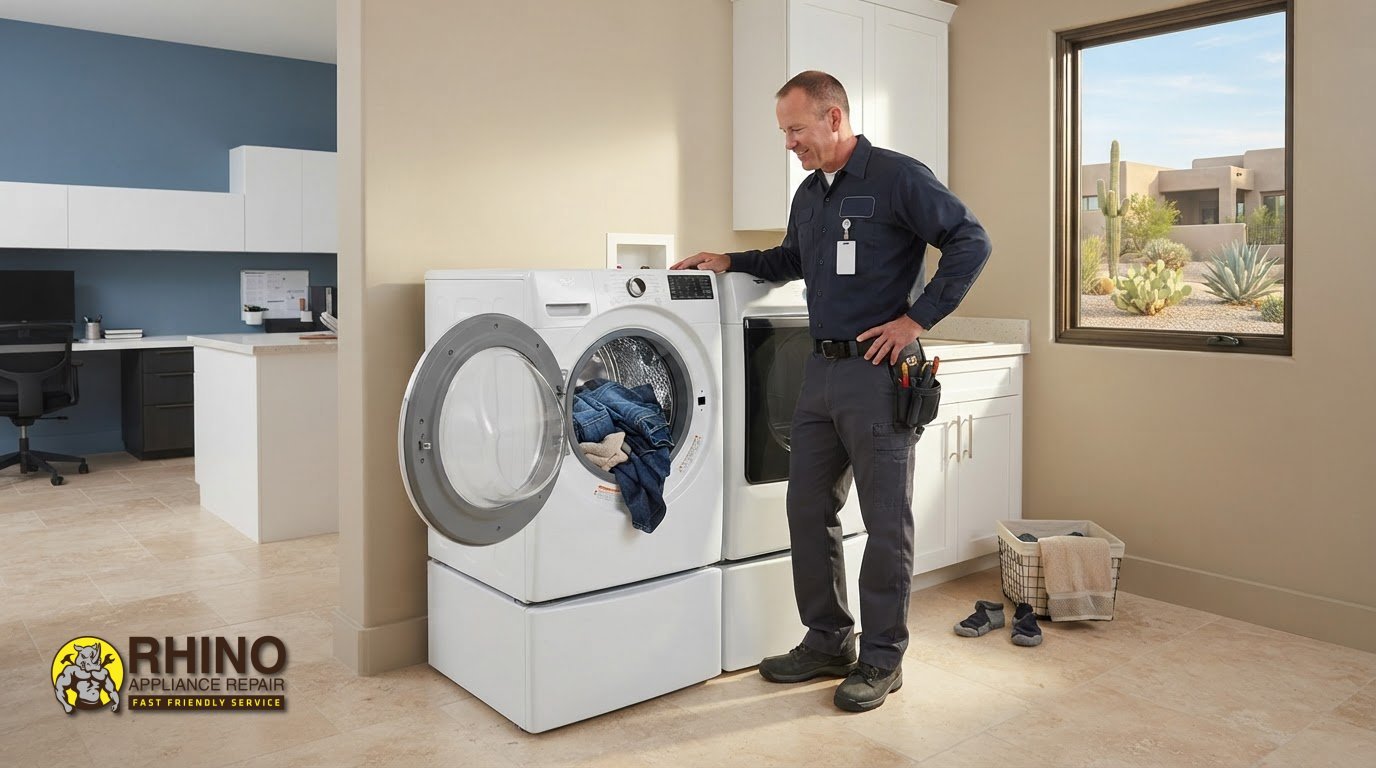
When a washer leaves clothes soaked, more than one problem could be involved. An unbalanced load can interrupt a spin, but a door or lid lock, a drive part, or another component may also be a factor. A few safe observations can help you describe the issue before arranging washer not spinning repair.
It’s frustrating to find wet laundry after a cycle. Notice whether the drum moved, whether the load was bunched to one side, and whether the washer displayed a message or made an unusual noise. These details are useful clues, not a diagnosis. Don’t open panels or handle wiring to investigate.
This guide covers common reasons a washer may stop spinning, simple observations you can make safely, and when to seek professional diagnosis. If the washer has a burning odor, damaged wiring, or water near electrical components, stop using it and seek qualified professional service. Rhino Appliance Repair provides residential washer repair in Gilbert, Chandler, Queen Creek, Mesa, Tempe, San Tan Valley, and nearby East Valley communities.
Key Takeaways
- Wet clothes after a cycle signal a spin problem, but they don’t identify one failed part.
- Load balance, drainage, cycle settings, controls, and mechanical issues may all be relevant to washer not spinning repair.
- Check the selected cycle and note whether the symptom returns. Leave internal inspection and repairs to a professional.
- Use the diagnosis, repair scope, and your household’s needs to weigh repair against replacement.
- Rhino Appliance Repair provides residential washer repair in Gilbert, Chandler, Queen Creek, Mesa, Tempe, San Tan Valley, and nearby East Valley communities.
Washer Not Spinning? Understand the Symptoms Before Assuming a Repair
The cycle ends, but the clothes are still unusually wet. That suggests the washer may not have completed an effective spin, but it doesn’t identify a failed part. A washer that isn’t spinning has not removed as much water from the load as expected, and the symptom can have multiple possible causes.
Describe what happened rather than guessing at the repair. A washer cycle includes different actions, such as washing, draining, and spinning. The Washing machine overview explains the appliance’s general function, but a wet load alone can’t show which part or cycle stage needs attention.
Notice the pattern. Did the washer skip spinning, or did the drum turn briefly and then stop? Did the cycle finish as usual or stop early? These details help describe whether the problem is a complete lack of spinning or weak or interrupted spinning. They’re clues to share, not proof of a specific fault.
What does it mean when a washer will not spin?
A complete lack of spinning may leave clothes dripping wet and gathered at the bottom of the drum. With weak or interrupted spinning, the washer may move the load but leave more moisture than usual. Both can look like a “no-spin” problem from the outside. The selected cycle and load conditions matter too, so don’t assume every washer has the same cause.
Cycle settings can affect what happens before the washer finishes. A heavy or unevenly distributed load may also affect spinning. If the cycle and load seem ordinary but the problem continues, the washer may need professional diagnosis. The symptom alone can’t confirm the cause.
Which details help describe the washer problem?
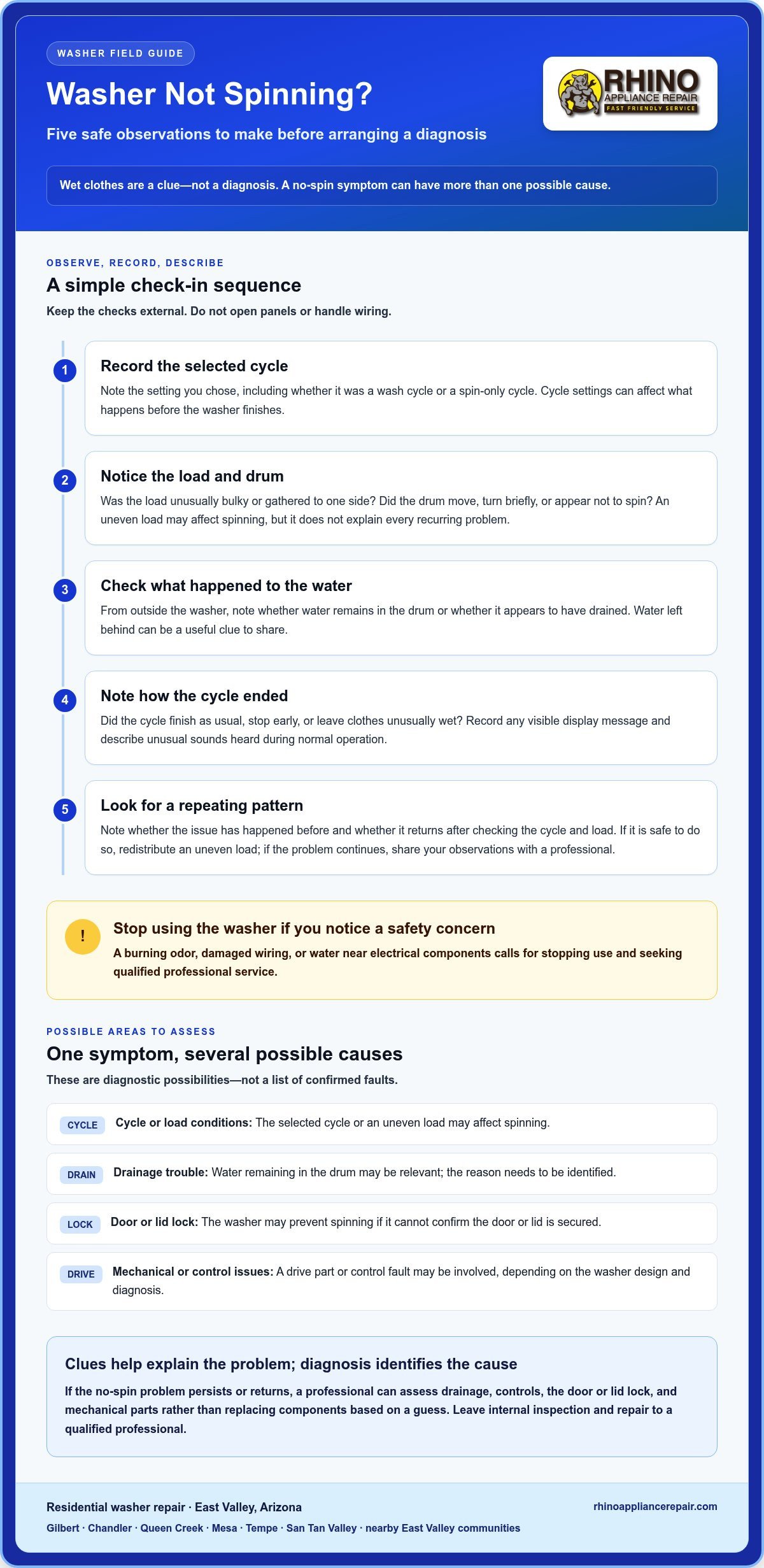
Before changing settings or starting another cycle, note what you can observe. Check whether water remains in the drum, whether the cycle stopped early, and whether the display shows a message. Record the selected cycle and whether the problem has happened before. Listen for unusual sounds during normal operation, but don’t open or dismantle the washer.
- Cycle: Record the setting you selected and whether it was a wash or spin-only cycle.
- What happened: Note whether the washer drained, stopped early, or left water in the drum.
- Pattern: Record whether the issue repeats and whether the load was unusually bulky or uneven.
- Sounds or messages: Describe any unusual noise or visible display message without trying to diagnose it yourself.
These observations make it easier to explain the problem when arranging washer not spinning repair. If the washer has a burning odor, damaged wiring, or water near electrical components, stop using it and seek qualified professional service.
Possible Causes of a Washer Not Spinning, and Why Diagnosis Matters
A washer’s spin cycle depends on several conditions working together. The cycle setting, load balance, drainage, controls, and mechanical parts may all be relevant. A clue can narrow the possibilities, but it doesn’t confirm a failed component. Washer not spinning repair should start with diagnosis, not a guessed fix.
Possible causes to investigate include:
- Cycle or load conditions: The selected cycle may not include the spin action you expected. An uneven load can also interfere with a balanced spin.
- Drainage trouble: If water remains in the drum, the washer may not move through its cycle as expected. The reason for poor drainage needs to be identified.
- Door or lid lock concerns: A washer may prevent spinning if it cannot confirm the door or lid is secured.
- Mechanical issues: Parts that transfer motion, such as a drive belt or motor coupling on applicable designs, may be involved.
- Control-related issues: A control fault may affect cycle operation, but a display message or interrupted cycle alone doesn’t prove that’s the cause.
Could a cycle setting or load condition affect spinning?
Yes. A cycle intended for a gentler wash may behave differently from a spin-focused option, while bulky items gathered on one side can make a load uneven. Check the selected cycle and, when safe, redistribute the laundry. If the washer still fails to spin normally, don’t assume the setting or load explains every occurrence.
When might a washer fault need professional diagnosis?
Arrange a diagnosis if the no-spin problem persists or returns after you’ve checked the cycle and load. A technician can assess whether drainage, controls, a door or lid lock, or a mechanical part is involved, rather than replacing parts based on a guess. One symptom can have several possible causes, and the appropriate repair depends on identifying the cause.
Internal inspection is different from a safe visual check. Don’t remove panels, handle wiring, or test electrical parts yourself. For general precautions, Electrical Safety for Home Appliance Repairs discusses risks involved in appliance repair. If you notice a burning odor, damaged wiring, or water near electrical components, stop using the washer and seek qualified professional service.
If the issue keeps returning, Rhino Appliance Repair provides residential washer repair to help identify the cause and determine an appropriate next step.
Washer Not Spinning Repair: Safe Checks Versus Repairs to Leave Alone
A few careful observations can help explain what the washer is doing without turning a basic check into a risky repair attempt. For washer not spinning repair, focus on the selected cycle, what you can see from outside the appliance, and whether the symptom returns. Don’t remove panels or reach inside to search for a cause.
What can a homeowner safely observe?
Keep checks simple and in order. Use the washer’s controls as intended, and stop if an observation would require touching wiring or internal parts.
- Note the selected cycle. Check whether you chose a wash cycle, a spin option, or another setting. Consult the owner’s manual for guidance specific to your washer’s model and cycle options.
- Record when the problem occurs. Note whether spinning doesn’t begin, stops partway through, or seems weak at the end. Also record whether the cycle finishes or stops early.
- Look for visible clues. From outside the washer, note any display message or visible leak. Don’t remove a panel to look for the source.
- Listen from a safe distance. Note unusual sounds during normal operation. Stop observing if the washer seems unsafe or the noise is concerning.
- Track whether it repeats. Write down whether the symptom returns and under what cycle or load conditions. A repeated pattern is useful information for diagnosis.
This is a way to gather details, not confirm a failed part. The Washing Machine Troubleshooting guide also discusses washer symptoms, but your washer’s manual is the place to look for model-specific user guidance. If ordinary observations don’t explain the issue, leave internal checks to a qualified repair professional.
When should you stop using the washer?
Stop using the washer if you notice a burning odor, damaged wiring, or water near electrical components, and seek qualified professional service. Don’t touch wet areas, wiring, or internal parts to investigate. A concerning electrical or water-related sign is not a reason to run another cycle to see what happens.
Live electrical testing and bypassing a lid lock, door lock, or another safety device aren’t homeowner checks. These actions can expose you to electrical hazards or disable protections built into the appliance. Leave internal electrical repairs and safety-device concerns to a qualified professional. If there’s no immediate safety concern but the no-spin symptom keeps returning, note what you observed and arrange a diagnosis rather than guessing at a part.
For a persistent problem, Rhino Appliance Repair provides residential washer repair to help identify the cause and determine the appropriate next step.
Repair or Replace? Fixing a Washer That Won’t Spin
A washer that won’t spin doesn’t automatically need replacement. First understand the cause, the repair involved, and whether keeping the appliance fits your household’s needs. Guessing can lead to a poor decision in either direction: replacing a washer before its fault is understood or committing to a repair without knowing what it addresses.
For washer not spinning repair, a professional diagnosis helps separate the symptom from the cause. A spin issue might relate to one component or connect to another cycle problem. If water also remains in the drum, for example, drainage should be considered as part of the diagnosis. Don’t assume separate symptoms share one cause or that they’re unrelated.
What information helps make a repair decision?
Consider the washer’s overall condition, not just the wet laundry. Share whether the symptom happens every cycle or intermittently, what you notice before it occurs, and whether the appliance has had other problems. A repair recommendation is more useful when it follows inspection and diagnosis rather than a guessed part.
- Diagnosis: What has been identified as causing the spin problem?
- Repair scope: What work is needed, and does it address the confirmed fault?
- Overall condition: Are there other recurring problems that affect your view of the appliance?
- Household needs: Would keeping the washer suit your laundry routine, or are there practical reasons to consider replacement?
There isn’t one replacement threshold that fits every home. Use the confirmed diagnosis and repair scope alongside the washer’s broader condition and your priorities. If drainage is also a concern, include that symptom in the discussion instead of treating it as proof of a particular fault.
How can you prepare for a washer repair appointment?
Clear details make it easier to explain the complaint and assess what needs attention. Have the washer’s brand and, if readily available, its model information on hand. Describe when spinning fails, whether the issue repeats, and what you’ve observed about draining or cycle completion. Share any display messages without trying to interpret them as a diagnosis.
Mention previous washer issues, too, while keeping them as separate observations. A past drainage concern and a current spin problem may be related, but only diagnosis can establish that. If you noticed a burning odor, damaged wiring, or water near electrical components, stop using the washer and report the safety concern when arranging service. Don’t try internal repairs before the appointment.
If a persistent spin problem needs professional attention, contact Rhino Appliance Repair for residential washer repair in the East Valley.
Local Washer Not Spinning Repair in the East Valley
A washer that leaves clothes wet can disrupt your household routine, especially when the cause isn’t obvious. Rhino Appliance Repair provides residential washer repair throughout the East Valley. A professional diagnosis can help distinguish between possible causes and identify an appropriate next step.
Washer not spinning repair starts with a clear account of what the appliance is doing. Describe whether the washer stopped before spinning, spun intermittently, or completed its cycle but left laundry unusually wet. These observations help frame the problem without guessing at a failed part.
What to share when requesting washer repair
Have the washer’s brand ready, along with a short description of when the issue occurs. If the display shows a message, share its wording without guessing what it means. Note whether the problem happens consistently or only with certain cycles or loads. Rhino commonly services major residential brands, including Samsung, LG, Whirlpool, GE, and Maytag.
Share related symptoms, such as water remaining in the drum, an interrupted cycle, or an unusual sound. If drainage is also a concern, describe it separately rather than assuming it explains the spin issue.
Be clear about safety concerns. If you’ve noticed a burning odor, damaged wiring, or water near electrical components, stop using the washer and report the issue when arranging service. Don’t run another cycle or inspect internal parts.
Get residential washer repair in your East Valley community
Rhino Appliance Repair serves East Valley homeowners, including those in Gilbert, Chandler, Queen Creek, Mesa, Tempe, and San Tan Valley. Business hours are Monday through Friday, 7:00 AM to 7:00 PM, and Saturday, 8:00 AM to 1:00 PM. The company is closed Sunday.
When you reach out, share the symptom, brand, and any visible messages or safety concerns. That gives the conversation a practical starting point without relying on a guessed diagnosis. For help with a washer that won’t spin, contact Rhino Appliance Repair for washer repair.
Get Back to a Clear Laundry Plan
A washer problem doesn’t have to force an immediate decision about replacement. Consider what you need from the appliance and what a diagnosis has established. That gives you a practical basis for choosing your next step instead of reacting to wet laundry or an uncertain guess.
With washer not spinning repair, the goal is to understand the problem well enough to make a choice that fits your household. Keep your observations handy and use the repair findings to decide what works best for your laundry routine.
Once the cause and options are clear, contact Rhino Appliance Repair for residential washer repair in the East Valley and decide on a plan that suits your home.
Frequently Asked Questions
Why is my washer not spinning but still draining?
A washer can drain water yet fail to spin the laundry as expected. Draining alone doesn’t identify the cause. For washer not spinning repair, note whether clothes are dripping wet or just damper than usual, and whether this happens with every load or only occasionally. If the symptom persists, arrange qualified diagnosis rather than assuming drainage or another single fault is responsible.
Can an unbalanced load stop a washer from spinning?
An uneven load can interfere with spinning, though it isn’t the explanation for every washer problem. Note whether the issue happens mainly with one bulky item or also with ordinary mixed laundry. If the pattern continues across different loads, avoid repeatedly running cycles to test a theory. Diagnosis can determine whether something beyond load conditions is involved.
What should I check first when my washing machine will not spin?
Start with the washer’s owner’s manual. It can clarify what the selected cycle is designed to do and explain displayed messages for your model. If a message appears, take a photo so you can share its exact wording. Don’t remove panels or investigate internal parts. If the manual’s user guidance doesn’t resolve the issue, a qualified technician can assess the washer.
Is it safe to keep using a washer that will not spin?
A no-spin symptom by itself doesn’t establish whether continued use is safe. Stop using the washer and seek qualified professional service if there’s a burning odor, damaged wiring, or water near electrical components. Don’t try another cycle to see whether a warning sign goes away. If none of those hazards is present but the problem keeps happening, arrange a diagnosis rather than relying on repeated cycles to complete laundry.
How do I know whether my washer needs repair or replacement?
A sound decision depends on the confirmed fault and the scope of the repair, not just the fact that the washer failed to spin. Ask the repair professional to explain what was found and how the proposed work addresses it. Then consider whether the washer’s condition and your household’s needs make continued use practical. The same symptom can lead to different choices in different homes.
Does Rhino Appliance Repair service washers in Mesa, Gilbert, and Chandler?
Yes. Rhino Appliance Repair provides residential washer repair in Mesa, Gilbert, Chandler, and other East Valley communities. When arranging service, share the city where the appliance is located and briefly describe the problem.
Which washer brands does Rhino Appliance Repair service?
Rhino Appliance Repair commonly services Samsung, LG, Whirlpool, GE, KitchenAid, Maytag, Kenmore, Electrolux, Frigidaire, Amana, Bosch, and other major residential washer brands. The company is not claiming manufacturer authorization or affiliation. If you’re unsure of the brand, check the visible badge on the washer and share what it says when describing the repair need.